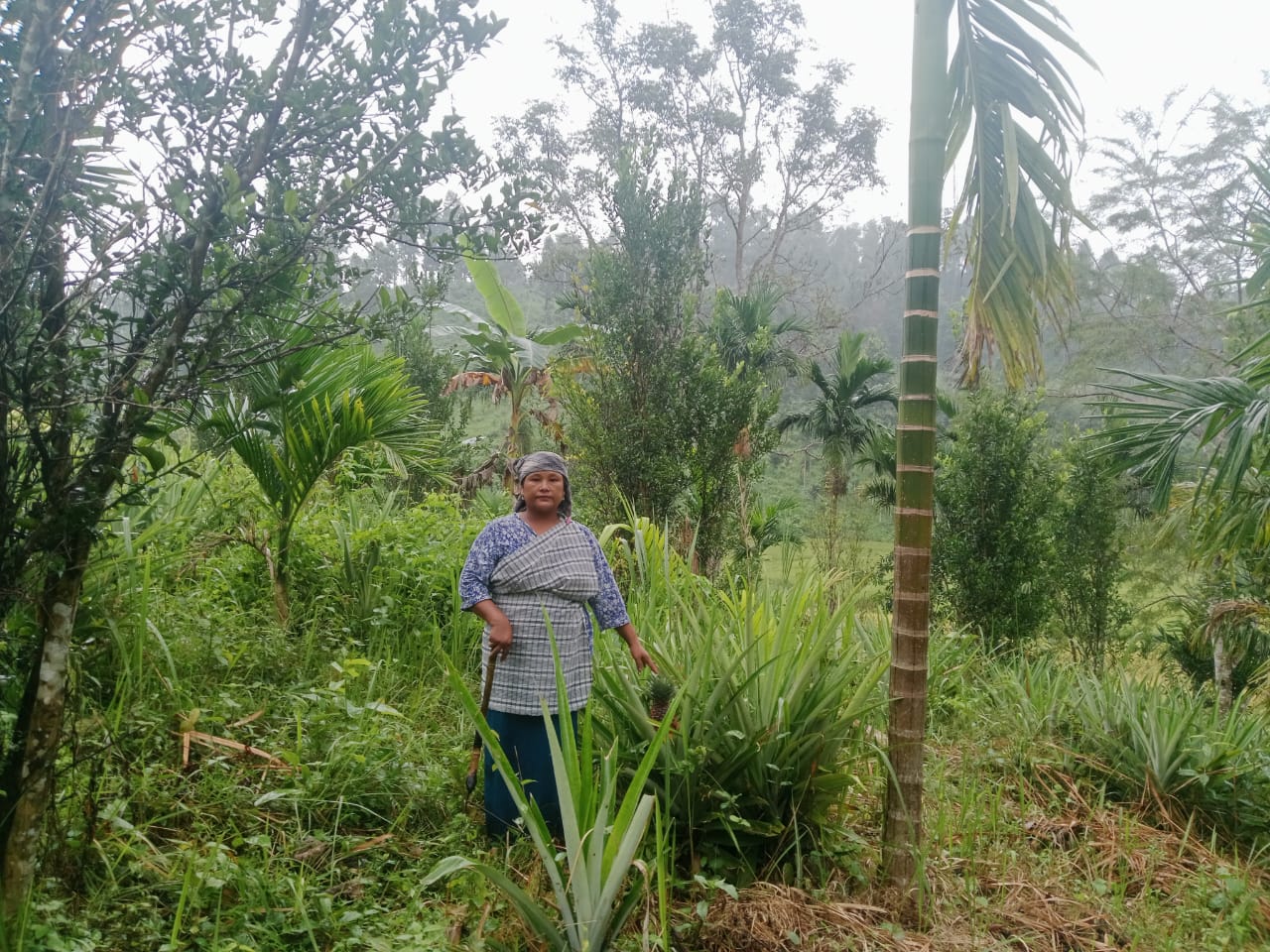


Meghalaya, India – Noni Lyngdoh, 39, a mother of five from Patharkhmah village, Jirang block, Ri-Bhoi district, struggled with limited market access, dependence on middlemen, post-harvest losses, and unstable crop prices. Though she cultivated a diverse range of crops and was an active member of her community, securing a stable income and improving her family’s nutrition remained difficult. Her situation reflected the broader challenges faced by many smallholder farmers in the region.
Everything began to change when Noni became part of the APFP-FO4A project and joined a Farmers’ Organization (FO), the Western Ri-bhoi Farmer Producer Cooperative Society. This connection opened doors to a wide network of smallholder farmers and access to essential capacity-building initiatives. Through trainings on sustainable farming, value addition, marketing, financial management, and cooperative governance, she strengthened both her technical skills and her confidence. The project also linked her with markets, input suppliers, and expert advisors, which helped her reduce post-harvest losses, improve crop quality, and increase her earnings. These opportunities not only uplifted Noni’s livelihood but also positioned her as an emerging role model in her community.
In 2023, the Western Ri-bhoi Farmer Producer Cooperative Society received funding from the APFP-FO4A program to establish a collection centre for raw pineapple, black pepper, broom grass, and ginger, and to procure machines for cleaning, grading, and processing these products. This facility strengthened value-chain opportunities for farmers like Noni, reducing dependence on middlemen and enabling more efficient, higher-quality processing and marketing.
The APFP-FO4A program is implemented by the Asian Farmers’ Association for Sustainable Rural Development (AFA) and La Via Campesina (LVC), with funding from the European Union (EU) and the International Fund for Agricultural Development (IFAD). The program aims to strengthen the capacities of farmers’ organizations to provide economic services, advocate for enabling policies, and promote sustainable livelihoods for small-scale family farmers across Asia. NEICORD is a national implementing agency of APFP-FO4A in India.
With support from the APFP-FO4A and the Western Ri-bhoi Farmer Producer Cooperative Society and with guidance from the North East India Committee on Relief and Development (NEICORD), Noni learned to manage her farm more strategically. She began planning production for both household consumption and commercial sale, monitoring market prices, and connecting directly with wholesale buyers and local vendors. By expanding vegetable cultivation for her family’s nutrition and marketing surplus produce, along with ginger, pineapple, arecanut, and lemon, she boosted her annual household income to around USD 2,100. Her experience shows how capacity-building, continuous guidance, and strong market linkages can empower smallholder farmers to secure both nutrition and economic stability.


Noni evolved from a resource-limited farmer into a forward-looking agri-entrepreneur. Starting with inherited land and minimal technical know-how, she embraced organic high-value crops, multi-cropping, and eco-friendly practices learned from project trainings. The FO strengthened her journey by providing market linkages, collective bargaining power, and a platform that amplified women’s voices. With these, she was able to scale her production sustainably, improve soil health, and promote biodiversity within her farm. Her transformation demonstrates how knowledge, collaboration, and sustainable practices can empower smallholder farmers to become environmentally conscious entrepreneurs.
Today, Noni serves as an inspiration for women farmers across Ri-Bhoi. She actively mentors peers, shares innovative farming methods, and encourages fellow women to participate in the FO. Her adoption of organic cultivation and improved farming techniques has resulted in a 15% increase in yield, contributing to better nutrition for her family and her community. By championing sustainable ecosystems and advocating for gender-inclusive decision-making, she strengthens social capital and motivates neighbouring villages to follow similar paths. Her leadership highlights the transformative impact of empowered women in rural agriculture.
Noni’s journey underscores a larger truth: when women farmers are equipped with sustainable practices, continuous training, and strong farmer organization support, smallholder agriculture can become both profitable and resilient. These approaches not only raise incomes and improve nutrition, but also nurture ecosystems, advance gender equity, and position women as pivotal leaders in rural development.