Background
Since 2021, the Farmer and Water Net (FWN) has been helping Farmer and Water User Communities (FWUCs) in Cambodia move beyond their traditional roles and explore new opportunities to earn additional income. While FWUCs mainly focus on maintaining irrigation schemes, operating water systems, and collecting irrigation service fees, the APFP-FO4A program opened a pathway for them to enter business operations, particularly through contract farming.
Innovations/Good Practices
With support from the APFP-FO4A program, FWN strengthened its assistance to one of its members, the Stung Chinit Farmer Water User Community (FWUC) in Kampong Thom province. Through the program, FWN received funding to procure quality rice seeds and fertilizer to improve rice production of the FWUC. This support enabled farmers to increase their yields and supply higher-quality paddy to buyers, laying a stronger foundation for the collective contract farming arrangement.
Impact
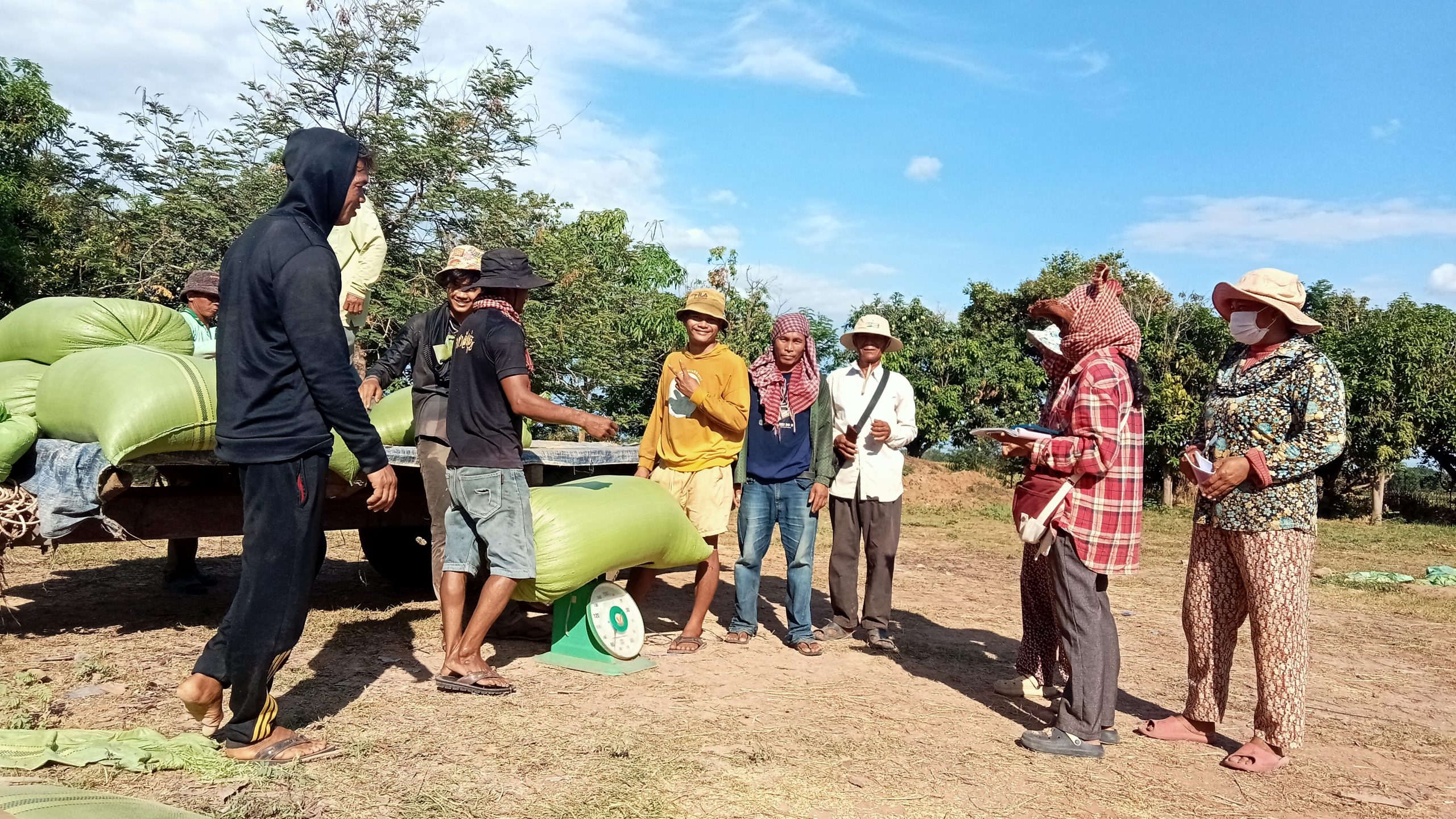
Through the guidance and facilitation from FWN, this community of 370 farming families, cultivating 600 hectares of paddy, formed a collective paddy-selling group. Through contract farming agreements, they sold their paddy at better prices to a local rice miller and a Vietnamese middleman. The results were significant: the community secured the sale of 2,780 tons of paddy (rice) between February and April 2025 alone. This initiative has strengthened household incomes and demonstrated how collective action can improve market access for smallholder farmers.
Facilitating factors
FWN played a crucial role in linking communities with buyers and ensuring that contract farming agreements truly benefited farmers. Before the activity began, FWN negotiated with company representatives to secure favorable terms, including:
- Clear contract farming conditions
- Assurance of high-quality paddy supply (up to 120 tons per day)
- Transparent cropping plans
- Better selling prices compared to daily local market rates
- Immediate payment upon delivery
Buyers also provided a facilitation or commission fee to the FWUC, helping support community services. Farmers expressed appreciation for this arrangement; they trusted the community, received fair prices, and were paid on time. Many farmers suggested expanding the paddy-selling group to diversify markets and further increase household incomes.
FWN’s facilitation has enabled the Stung Chinit FWUC to successfully operate a collective paddy-selling group, benefiting 370 families. Through contract farming, the community secured favorable prices and sold 2,780 tons of paddy rice, significantly boosting farm incomes and strengthening the FWUC’s role in local economic development.
FWN supported the FWUCs in multiple ways to strengthen their engagement in collective paddy sales. This included assessing the buying capacities of rice millers, facilitating negotiations between FWUCs and millers, and identifying new contract farming opportunities. FWN also helped communities meet buyer requirements related to quantity, quality, and delivery schedules, while sharing updated information with millers on available rice varieties and volumes. The organization acted as a witness or guarantor in business transactions and assisted members in posting accurate data on the upcoming CRF paddy selling platform. Additionally, FWN assessed the year-round paddy supply capacity of each FWUC, provided consultations on forming Paddy Selling Groups (PSGs), consolidated selling calendars, and delivered them to FWN for coordination. To build long-term capacity, FWN shared experiences, offered training on quality control and planning, and coached PSG leaders on accessing agricultural inputs and machinery services.
Furthermore, FWUC committees played an essential role in ensuring the smooth operations of the paddy-selling groups. They organized consultations with members, collected necessary information for PSG formation, and validated individual selling schedules. The committees also communicated sales plans to FWN and other stakeholders and identified common collection points for gathering paddy. Their responsibilities included gathering, checking, and classifying the paddy, delivering the batches to buyers, and managing payment settlements between millers and PSG members, ensuring transparency and trust throughout the process.
Lessons learned
The initiative revealed several key lessons. Even rice of lower quality can still meet the requirements of export-oriented mills, offering farmers more selling opportunities than they previously expected. However, public holidays can disrupt purchase schedules, as millers often halt buying during these periods. The community also observed sharp price fluctuations in the market, which increased competition with middlemen. Additionally, some members still have limited understanding of the purpose and principles of the Paddy Selling Group (PSG), highlighting the need for continued capacity building and awareness efforts.
Recommendations
FWN recommends expanding and forming additional paddy-selling groups to include more members and broaden market participation. Strengthening the capacity of PSG leaders in quality control is also essential to ensure consistent product standards. Furthermore, improving access to market information, particularly regarding Vietnamese buyers interested in contract farming partnerships, will help farmers secure better opportunities and more stable selling arrangements.


The Asia-Pacific Farmers’ Program (APFP)–Farmers Organizations for Asia (FO4A) is implemented by the Asian Farmers’ Association for Sustainable Rural Development (AFA) and La Via Campesina (LVC), with funding from the European Union (EU) and the International Fund for Agricultural Development (IFAD). The program aims to strengthen the capacities of farmers’ organizations to provide economic services, advocate for enabling policies, and promote sustainable livelihoods for small-scale family farmers across Asia. In Cambodia, the program is implemented by the Farmer and Nature Net Association (FNN) in partnership with other national farmers’ organizations in the country.