Background
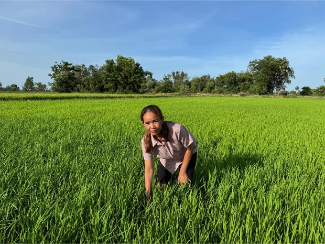
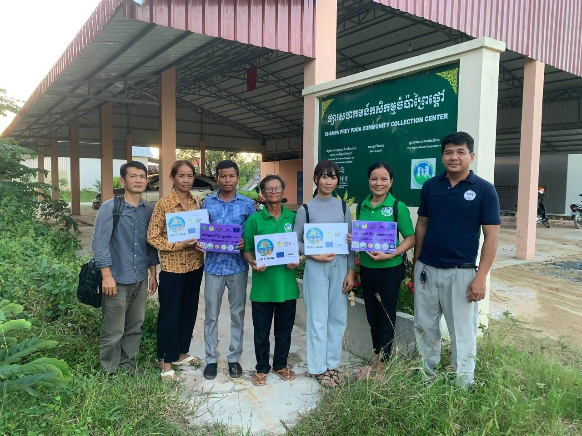
The Champa Preyphdao Agricultural Cooperative was officially registered with the Provincial Department of Agriculture, Forestry and Fisheries (PDAFF) of Takeo, Cambodia on 13 January 2016. Located in Samroung Village, Champa Commune, Prey Kabas District, Takeo province, the cooperative has grown into a key economic actor supporting smallholder farmers in the area. It currently has 1,503 members, including 355 women and 129 youth, and operates five main business services: rice seed production, agricultural input (fertilizer) supply, rice wine supply, collective marketing of safe vegetables and fruits, and credit services.
Since 2022, the cooperative has been a registered as a member of the Association Federation of Farmer Community Promoting Family Agriculture Enterprise in Cambodia (FAEC).
Innovations/Good Practices
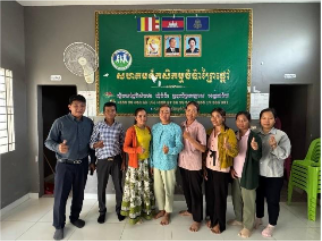
Under the APFP-FO4a program, FAEC collaborated with the Farmer and Nature Net Association (FNN), the national implementing agency of the APFP-FO4A program in Cambodia, to support the cooperative through the Farmers’ Or Service Development component. This included training committee members on business plan development and providing regular online counselling to ensure the plan was accurate, practical, and aligned with market opportunities. As a result, the cooperative successfully developed and submitted its business plan to the program’s regional implementing agency to mobilize funding. In December 2023, the cooperative secured a grant of USD 9,250, which is to be used expand its business and economic services for member farmers for three years.
The Asia-Pacific Farmers’ Program (APFP) – Farmers’ Organizations for Asia (FO4A) is implemented by the Asian Farmers’ Association for Sustainable Rural Development (AFA) and La Via Campesina (LVC), with funding from the European Union (EU) and the International Fund for Agricultural Development (IFAD). The program aims to strengthen the capacities of farmers’ organizations to provide economic services, advocate for enabling policies, and promote sustainable livelihoods for small-scale family farmers across Asia.
The cooperative applied a participatory development approach, engaging farmer members, the governance body, and national farmers’ organizations (NFO) partners (FAEC and FNN) in business implementation, intervention design, and monitoring. Regular counseling on business implementation, reporting, and monitoring was conducted through online meetings and social media platforms such as Telegram, facilitated by FAEC and FNN.
Furthermore, the cooperative has established strong collaboration with private sector buyers through contract farming, particularly for safe vegetables, fruits, and agricultural fertilizer businesses. Business retention is strengthened through regular exchanges on needs, challenges, and solutions, helping to ensure long-term partnerships.
Impact
These good practices enabled the cooperative to diversify its income sources and improve farmers’ incomes.
Over 18 months of business implementation (January 2024 to June 2025), approximately 14.1 metric tons of safe vegetables and 12.8 metric tons of fruits, particularly yellow watermelon, were marketed to 12 buyers, including wholesalers and organic shops in Phnom Penh, under contract farming arrangements. This generated income of USD 10,486 from safe vegetables and USD 4,765 from fruits, benefiting 63 smallholder farmers cultivating a total of 10 hectares of farmland.
In the rice seed business, the cooperative sold 1.87 metric tons to 17 smallholder farmers, generating USD 1,856.
For fertilizer services, over 24 MT were sold to 38 smallholder farmers, earning USD 17,025.
Overall, during the 18 months of business plan implementation, the Champa Preyphdao Agricultural Cooperative significantly improved its business performance, generating total income of USD 34,311 and a net profit of USD 1,735.
Farmers engaged in the cooperative’s business activities gained better access to markets and received higher prices compared to regular markets. At the same time, the cooperative’s management capacity was strengthened, particularly in financial management and literacy. Member farmers increased their income and gained access to quality agricultural inputs to enhance productivity. In addition, household food consumption improved through access to healthier products, and farmers’ positions within value chains were strengthened.
The APFP-FO4A program, implemented through FAEC, contributed to strengthening the Champa Preyphdao Agricultural Cooperative’s economic services and improving management capacity, enabling the cooperative to better support smallholder farmers in increasing incomes, improving rural livelihoods, and promoting environmental sustainability within the community. In parallel, the cooperative has strengthened collaboration with the project, government agencies, the private sector, and other stakeholders to enhance the effectiveness and long-term sustainability of economic services for member farmers.
The good practices implemented by the cooperatives have demonstrated positive and measurable results which can be replicated by other FAEC member cooperatives and NFOs with similar conditions and can be scaled up to benefit a larger number of cooperatives and smallholder farmers. Looking ahead, the cooperative believes that expanding these good practices will further contribute to rural economic growth, job creation, and sustainable development.
Challenges
Although the cooperative’s business plan has progressed positively, several challenges were encountered. Some buyers who signed contract farming agreements did not fully comply with agreed prices and payment terms, creating cash flow difficulties for the cooperative. Additionally, rising fuel and agricultural input prices led farmers to reduce input use, affecting productivity and profitability.
Climate-related challenges, such as prolonged rainfall and drought, also caused production losses and reduced farmers’ yields and incomes.
Recommendations
The cooperative committee recommends that FAEC and the project continue supporting cooperatives by expanding services and providing additional investment capital. This would enable cooperatives to increase their purchasing capacity and secure better and more stable prices for member farmers’ products.
They also request continued capacity building for farmers and cooperatives, particularly in agricultural techniques (vegetables, poultry, rice, fish), digital marketing, financial management, and improved market access, including contract farming facilitation, in future project phases.