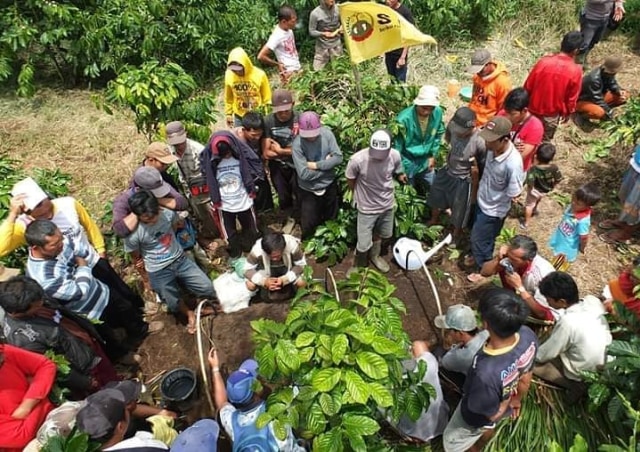
The Serikat Petani Indonesia (SPI) (Indonesian Peasant Union) continues to realize its concern for Indonesian agriculture, especially coffee cultivation by the community. According to Hendarman, Chairman of SPI Bengkulu Region, SPI wants to oversee the entire stages of community coffee cultivation, from the production chain to marketing.
“In Bengkulu, SPI facilitates coffee commodities from upstream to downstream, from blending to building alternative markets,” said Hendarman. To facilitate communication, SPI Bengkulu developed a cooperative with the hope of integrating and better controlling the entire business cycle. SPI also built a cafe managed by young farmers and students.
The cafe aims to make coffee supplies go directly from farmers to coffee-loving consumers without going through middlemen. “We roast it ourselves. We guarantee our coffee is delicious and worth drinking. What’s interesting is that consumers come and are willing to pay a high price,” explained Hendarman.
In addition, SPI Bengkulu also created several programs facilitated by the National Leadership Council of SPI through the APFP-FO4A program. One of the programs is encouraging youth groups or millennials to become entrepreneurs.
The Asia-Pacific Farmers’ Program (APFP) – Farmers’ Organizations for Asia (FO4A) is implemented by the Asian Farmers’ Association for Sustainable Rural Development (AFA) and La Via Campesina (LVC), with funding from the European Union (EU) and the International Fund for Agricultural Development (IFAD). The program aims to strengthen the capacities of farmers’ organizations to provide economic services, advocate for enabling policies, and promote sustainable livelihoods for small-scale family farmers across Asia.


Eight (8) out of ten (10) districts in Bengkulu Province are coffee-producing areas. So SPI Bengkulu sees the need to continue rolling out educational activities about coffee to continue the regeneration of farmers and their coffee to a higher level.
“A more specific program to encourage farmer families to be more prosperous is to encourage Bengkulu’s millennial farmers to produce good quality and quantity coffee to be supplied to big cities,” added Hendarman.
In the future, SPI Bengkulu will continue to coordinate with all policy makers from village to province. In addition, Hendarman also plans for farmers to have a showcase as a collective space for the entire farming community to display their products.
“We hope policy makers present among us, the farmers. They can see and understand that farmers need support, not just equipment distributed to farmers, but support for other accesses,” Hendarman continued with full of hope. “For example, capital stimulus, and improving market guarantee capabilities. We hope SPI’s vision and mission to improve farmers’ welfare and sovereignty can be realized”.