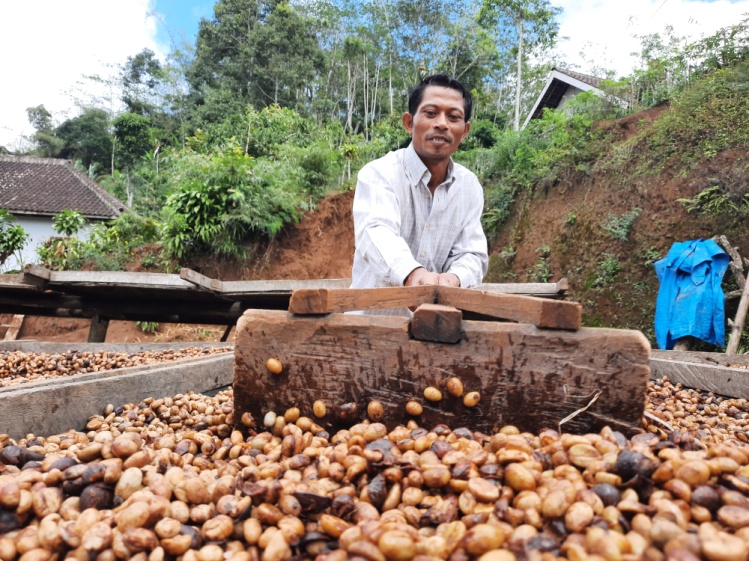


Increasing productivity, improving post-harvest processing, and marketing access have successfully increased farmers’ income by 53.78%, or from IDR 27,800,000 (USD 1,650) per hectare to IDR 42,750,000 (USD 2,540) per hectare. The Aliansi Petani Indonesia (API) (Indonesian Peasants’ Alliance), together with the Robusta Coffee Farmers Association “SRIDONORETNO” and Sridonoretno Makmur Bersama Cooperative, made these efforts to improve the welfare of small farmers in three villages, namely Srimulyo Village, Sukodono Village, and Baturetno Village.
The Sridonoretno Farmers Association has been a member of API since 2014. “Sridonoretno” is an abbreviation for the names of three villages, which are Srimulyo, Sukodono, and Baturetno. These three villages are located in Dampit District, Malang Regency, East Java. Coffee plantations owned by farmers in these three villages are located in the Semeru mountain area at an altitude of 400 to 900 meters above sea level. In addition to robusta coffee, which is a major potential in these three villages, bananas and snake fruit (salak) are also cultivated by farmers.
The development of coffee plants in Sridonoretno started in the Dutch colonial era. The Dutch opened coffee plantations in the three villages since the area is very fertile and suitable for coffee cultivation. After Indonesia’s independence from the Dutch on August 17, 1945, these plantations have been managed by farmers, and some areas have been inhabited by villagers.
The challenges faced by farmers in the three villages are the very low productivity of coffee plants. Meanwhile, the high terrain makes it difficult for farmers to transport fertilizers such as urea or ponska (a compound fertilizer consisting of nitrogen, phosphorus, potassium, and sulphur) to the coffee plantations, resulting in inadequate care for the coffee plants.
From 2010 to 2020, the price of coffee beans at the farmgate was very low, which amounted to around IDR 19,000 to IDR 22,000 per kilogram (less than USD 1 per kilogram). The low price at the farmgate was due to the farmers’ limited knowledge of post-harvest processing, resulting in low-quality coffee beans. Additionally, the lack of market information and dependence on middlemen limited the farmers’ options for selling to better markets. Furthermore, the absence of economic institutions such as cooperatives meant that farmers could only sell their harvest in bulk.
Meanwhile, there is a high demand for specialty/fine coffee among the middle class, particularly through cafes.
To address these challenges and opportunities, API and the Sridonoretno Farmers Association, with support from the MTCP2-AFOSP and its succeeding phase, APFP-FO4A program, implemented strategies to strengthen farmer institutions, increase productivity and improve coffee cultivation systems, improve post-harvest processing, enhance coffee bean quality, and build partnerships with various parties to increase access to markets for high-quality coffee beans.
The Asia-Pacific Farmers’ Program (APFP) – Farmers’ Organizations for Asia (FO4A) is implemented by the Asian Farmers’ Association for Sustainable Rural Development (AFA) and La Via Campesina (LVC), with funding from the European Union (EU) and the International Fund for Agricultural Development (IFAD). The program aims to strengthen the capacities of farmers’ organizations to provide economic services, advocate for enabling policies, and promote sustainable livelihoods for small-scale family farmers across Asia.
Strengthening farmer institutions
API and the Sridonoretno Farmers Association took the first step to hold member meetings and consolidate each group. This activity aimed to ensure a better price for robusta coffee, so that farmer groups had to carry out proper post-harvest processing in each collective processing unit. The farmer groups also had to establish a quality assurance system in each group and build marketing through cooperatives.
The process of developing potential business undertaken by the Sridonoretno Farmers Association and Koperasi SDR Makmur Bersama started with processing red-picked coffee beans (selective picking), then processing them with quality control according to standards. The coffee produced by Koperasi SDR Makmur Bersama is marketed in the form of green beans, roasted beans, and ground coffee, packaged and ready for consumption.
Currently, the Sridonoretno Farmers Association and Koperasi SDR serve 500 coffee farming households as coffee producers, which are grouped into 18 farmer groups with a harvest potential of up to 600 tons per year. Around 250 coffee farming families apply the red-picking system, resulting in 10 to 25 tons per year. Meanwhile, demand from the cafe network can reach 50 tons per year,
Increased productivity
Koperasi SDR Makmur Bersama has several goals, including:
- Improving farmer welfare through increased income and quality of life
- Enhancing coffee quality with ideal post-harvest management standards
- Promoting local coffee to national and international markets
Increased productivity and cultivation systems are greatly needed by coffee farmers who are members of the Sridonoretno Farmers Association. API and Sridonoretno farmers then organized a field school on coffee cultivation and integrated pest control to boost productivity. Learning topics introduced at the field school included side-grafting techniques for coffee plant rejuvenation, pruning, intercropping, liquid fertilizer production, and its application on coffee plants. Additionally, cooperative members also learned to apply sustainable farming practices such as agroecology and crop diversification.
The field school, which started in 2016, has produced 18 farmer groups covering 500 farmers. With this field school, the Sridonoretno Farmers Association has been able to improve the coffee cultivation system, thereby increasing productivity. Farmers’ income has also increased by 53.78% from IDR 27,800,000 (USD 1,650)per hectare per year to IDR 42,750,000 (USD 2,540) per hectare per year.
Quality improvement
To maintain quality, coffee cherries must be processed promptly and properly so they can be safely stored for a certain period. Coffee bean quality criteria include physical aspects, moisture content, cleanliness, and uniformity. Maintaining this quality will result in a delicious coffee flavor. Cleanliness, uniformity, and consistency in processing are determined by treatment at each stage of production. Therefore, the production process stages and specifications of coffee processing equipment will determine the quality of the coffee produced.
From 2017 to 2018, API and the Sridonoretno Farmers Association held a training for 18 farmer groups and 8 Processing Units on quality coffee processing. This activity aimed to improve the quality of coffee beans produced by members of the Sridonoretno Farmers Association and Koperasi SDR Makmur Bersama. The training introduced 9 processing stages to turn red coffee beans into quality robusta coffee.
The Sridonoretno Farmers Association and Koperasi SDR Makmur Bersama strive to provide high-quality coffee beans. Eight Processing Units play a role in processing and quality control. With improved post-harvest processing and coffee bean quality, the price of coffee beans at the farmer level increased by 77.27%, from IDR 22,000 (US 1.31) per kilogram to IDR 39,000 (USD 2.32) per kilogram. Meanwhile, the selling price of coffee beans at the cooperative level is IDR 43,000 (USD 2.56) per kilogram.
Building partnerships with coffee shops and government
In the process of building partnerships to increase market access, API, together with the Sridonoretno Farmers Association and Koperasi SDR Makmur Bersama, conducted a mapping of cafe needs and built a multi-party platform to promote coffee produced by the Sridonoretno Farmers Association and processed by Koperasi SDR Makmur Bersama under the SDR coffee brand. API also facilitated the cooperative to promote SDR coffee through exhibitions, seminars, and farmer meetings with market players in various activities attended by API at regional, national, and international levels, such as product exhibitions and Indonesia Coffee Week.
Up to now, Koperasi SDR Makmur Bersama has supplied 280 cafes in Malang Raya and Surabaya, and some have also distributed to cafes in Jakarta and Yogyakarta. The demand for SDR robusta coffee beans reaches 50 tons per year, while Koperasi SDR Makmur Bersama can only fulfill 25 tons per year due to limited coffee processing facilities, particularly drying houses and storage warehouses.
Koperasi SDR Makmur Bersama needs to increase its red-coffee bean processing capacity to meet existing market demand and share. Meanwhile, API facilitated cooperation with BUM-Desa Raharja (Raharja Village-Owned Enterprise) in Sukodono Village through the PIID PEL (Pilot Village Innovation Incubation for Local Economic Development) program from the Ministry of Villages and Disadvantaged Regions.
Through cooperation between the Cooperative (Koperasi SDR Makmur Bersama) and BUM-Desa Raharja, the Ministry of Villages supported by allocating IDR 1,500,000,000 to BUM-Desa Raharja as their assets. The funding is intended for procurement of processing facilities, such as drying houses, warehouses, working capital, and incubation, such as training and mentoring. The cooperative can utilize these facilities. In this program, API plays the role of an incubator and provides capacity building for human resources at Koperasi SDR Makmur Bersama and BUM-Desa Raharja.
Social and economic impact
The economic impact of the increased added value of the Sridonoretno Robusta Coffee Farmers Association from 2015 to 2019 is the quality of coffee production, from 0 to 50 tons per year. There was also an increase in farmer income from IDR 27,800,000 per hectare per year to IDR 42,750,000 per hectare per year. This increased added value is due to the better quality of coffee beans.
The social impact resulting from API’s services and support from various parties, including the government, is the availability of 1,300 daily workers per year, involving 20 women in post-harvest processing per season, while the number of professional farmers increasing from 125 to 425 farmers due to the impact of increased farmer knowledge.
Success from strategic collaboration and market expansion
The year 2024 marks a year of achievements for Koperasi Sridonoretno as an economic pillar for farmers in three villages, and a milestone in the cooperative’s journey. Sridonoretno Cooperative (SDR) has successfully shown that community-based management can improve members’ welfare while supporting environmental sustainability. Established with a spirit of mutual cooperation and initially focusing on strengthening the local coffee farmers’ economy, the cooperative has become a symbol of transformative change, inspiring other cooperatives in Indonesia to continue innovating and strengthening their role in building a community-based economy, thanks to various innovations and strategic collaborations.
Koperasi SDR Makmur Bersama exceeded expectations by launching premium processed coffee products and ready-to-drink beverages. These products are marketed not only locally but also nationally through various digital platforms. This move boosted the cooperative’s turnover to reach two billion rupiah (USD 118,842) in 2024. For its achievements, Koperasi SDR Makmur Bersama received the “Innovative and Sustainable Cooperative 2024” award from the Ministry of Cooperatives and SMEs. This award proves that cooperatives can be agents of change for society and the environment.
The success of Koperasi SDR Makmur Bersama is inseparable from strategic partnerships with local governments, the private sector, and civil society organizations. Thanks to this support, Koperasi SDR has successfully penetrated international markets. As a community-based organization, Koperasi SDR doesn’t just focus on profit. Through social funds, the cooperative helps surrounding communities by building clean water facilities and providing educational scholarships for farmers’ children.
Koperasi SDR Makmur Bersama is committed to continuously improving farmers’ quality of life and preserving environmental sustainability. By leveraging technology and expanding market networks, the cooperative is optimistic about achieving more successes in the future.