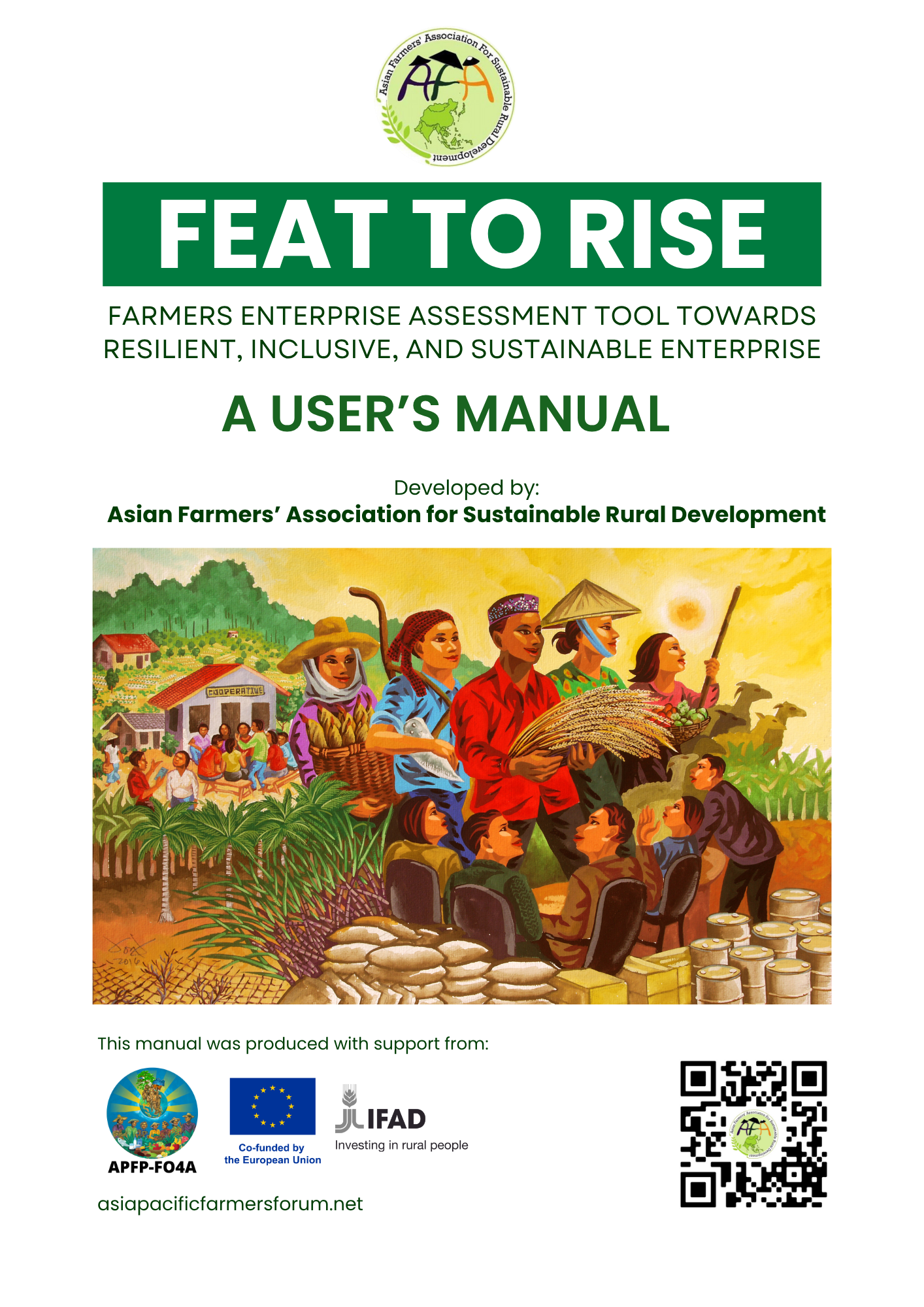
FEAT TO RISE
Farmers Enterprise Assessment Tool Towards Resilient, Inclusive, and Sustainable Enterprise
A User’s Manual
Developed by the Asian Farmers’ Association for Sustainable Rural Development (AFA)
Background
What is FEAT to RISE? The Farmers’ Enterprise Assessment Tool towards Resilient, Inclusive and Sustainable Enterprise (FEAT to RISE, from here on referred to as FEAT for ease of reading in the succeeding pages of the manual) is a practical, participatory, and user-friendly instrument developed to help Farmers’ Organizations (FOs) and cooperatives systematically evaluate the strengths and gaps in their enterprise operations and craft actions to improve their businesses. By encouraging collective reflection, it enables members to build a shared understanding of their current performance while fostering evidence-based planning, informed decision-making, and continuous improvement. FEAT evaluates performance across five important pillars: Organizational Maturity and Growth, Profitability and Financial Stability, Productivity and Market Access, Inclusivity and Equity, and Sustainability — through a structured assessment of governance and leadership, financial management, business performance, value chain integration, member participation, gender and youth inclusion, and environmental impact. This provides a holistic framework for continuous improvement and enterprise growth.
Why was FEAT developed? The Farmers’ Enterprise Assessment Tool (FEAT) was created in response to the growing recognition that farmers’ organizations need more than external funding to succeed. To truly thrive, FOs require structured, context-sensitive tools that enable them to assess and strengthen their organizational and enterprise operation capacities.
Traditional assessment methods often overlook the unique challenges and potential of grassroots-level organizations. FEAT addresses this gap by offering a practical, participatory, and empowering approach that allows FOs to take ownership of their development. It helps them identify their strengths and weaknesses and supports the design of targeted, actionable plans? for their business growth.
Who developed and funded FEAT? The Farmers’ Enterprise Assessment Tool (FEAT) was developed by the Asian Farmers’ Association (AFA), with contributions from various national/local Farmers’ Organizations and agricultural agencies such as AgriCord under the Asia Pacific Farmers Program (APFP) – Farmers Organization for Asia (FO4A) platform. Its development was made possible through funding and technical support from the International Fund for Agricultural Development (IFAD) and the European Union (EU).
Uses & Benefits of the Farmers Enterprise Assessment Tool (FEAT)
This user-friendly tool helps cooperatives and farmer organizations (FOs) reflect on their current status and identify actions to strengthen their enterprises. It promotes a participatory and recurring process that begins with an FO-led self-assessment, is followed by external validation using available records and financial documents, and culminates in a joint analysis and planning session.
FEAT’s regular use applies not only at the organizational or project level but also to commodity-specific enterprises. FOs may align assessments with their seasonal production and marketing cycles (e.g., pre-planting, harvest, post-harvest, or annual trading periods). This ensures that enterprise performance is reviewed at critical points in the cycle, making plans and decisions more timely and responsive to commodity realities.
The results provide a practical reference for both annual and seasonal planning, guide resource prioritization, and help address weaknesses while building on strengths. They also give partners a clear basis for identifying appropriate areas of support and intervention.
How has FEAT been used? Over the past years, FEAT has been implemented as part of the Asia Pacific Farmers’ Programme (APFP) and the Farmers’ Organizations for Asia (FO4A) programme to assess the economic operations of the Farmers’ Organizations in 15 countries. The process involved an initial self-assessment conducted by each FO, followed by the RIA (the consortium AFA and LVC) validation to ensure accuracy, objectivity, and credibility.
This dual-layered assessment provides valuable insights into each organization’s enterprise operational strengths and areas for improvement. These insights serve as the foundation for comprehensive action planning, enabling FOs to pursue continuous growth and enhanced impact on increased income of farmers and their organizations.
Why need a manual? To ensure consistent application and to maximize the value of the assessment process, this manual serves as a step-by-step guide to using FEAT effectively. It provides users with the necessary context, procedures, tools, and examples to implement the assessment in a way that is participatory, reflective, and action-oriented. The manual also helps standardize the process across different contexts, while allowing room for adaptation.
Structure of the Manual. This manual is structured to guide users through each stage of the FEAT process. It begins with this introductory chapter, which outlines the purpose, users, and benefits of the tool. Subsequent chapters are organized as follows:
Chapter 1: Introduction
Chapter 2: Conceptual Framework and Tool
Chapter 3: FEAT Process
Chapter 4: Integrating FEAT into Organizational Practice
Annexes
Users are encouraged to refer to the manual as needed, adapting the content to fit their specific context while maintaining the integrity of the tool’s methodology.
Objectives of the FEAT
The FEAT was designed not only as a diagnostic tool but also as a catalyst for enterprise development. While it fosters organizational strengthening and transformation, its primary orientation remains towards enhancing enterprise capacity and performance. Its application contributes to several key objectives:
- Strategic Planning: Support informed decision-making by identifying strengths and gaps, enabling FOs to set realistic goals aligned with enterprise development and market opportunities and transition to the next level of performance.
- Capacity Building: Highlight priority areas that strengthen business management, governance, and technical skills critical for sustainable enterprise operations.
- Investment Readiness: Provide development partners and investors with a structured assessment of organizational strength and enterprise systems to determine readiness for funding, partnerships, and market engagement.
- Broader Organizational Learning: Foster a culture of reflection and continuous improvement, enabling FOs to adapt business models and enterprise practices to changing environments.
Target Users
The Farmers Enterprise Assessment Tool (FEAT) is intended for a broad range of stakeholders engaged in the development, support, and governance of smallholder agricultural systems. It is designed to be inclusive, adaptable, and accessible, whether used directly by Farmers’ Organizations for self-assessment or facilitated by external actors such as NGOs, government agencies, or development partners.
The following outlines the specific groups of target users and their roles in applying the tool.
- Farmers’ Organizations (FOs): As primary users, FOs can use FEAT for self-assessment, organizational learning, and to communicate their development trajectory to external stakeholders.
- NGOs and Facilitators: Organizations that provide support services to FOs can use FEAT as a framework to guide their interventions, monitor progress, and co-create development plans with farmer groups.
- Government Agencies: Policymakers and agricultural extension services can employ FEAT to understand the needs and capacities of grassroots organizations, inform policy, and allocate resources effectively.
- Development Partners: Donors, investors, and multilateral agencies can use FEAT as a tool to assess organizational health and capacity before committing resources, ensuring that support aligns with actual needs and priorities.
- Banks: Government banks, MFIs, commercial banks can use FEAT as a tool to assess whether the FO is ready for investments and be included in their pipeline of potential clients for further review
Key Features
- User-friendly: Designed for ease of use by FOs for internal reflection and self-diagnosis.
- Participatory: Involves members and leaders of the FO in a collaborative process.
- Regular: Conducted on a recurring basis (aligned with commodity seasons, project timelines, or annually) to track progress and changes over time.
- Farmer-driven and learning-oriented: Led primarily by FOs as a tool for self-assessment, learning, and adaptive management—rather than as an externally imposed accountability or data collection exercise.
- Enterprise-focused: Concentrates on strengthening the FO’s enterprise operations and performance, rather than serving as a general organizational development (OD) assessment.
- Structured: Follows a clear cycle starting with FO-led self-assessment, then external validation culminating in joint analysis and action planning for transition to higher levels of performance.
Customizing FEAT for IFAD-Supported Projects
FEAT is designed as a flexible tool that can be adapted to the diverse realities of Farmers’ Organizations across country contexts, particularly within IFAD-supported projects operating in varied institutional, socio-economic, and cultural environments.
This manual provides guidance on how to adapt FEAT without compromising the integrity of the framework — including translating tools, contextualizing indicators, and adjusting facilitation approaches to local norms and organizational practices.
It also clarifies FEAT’s structure, scoring logic, and assessment process; the complementary roles of self-assessment and external facilitation; and how FEAT applies to varied organizational situations such as multi-value chain operations, partial membership coverage, and need-based service delivery.
Throughout the manual, practical tips and examples support context appropriate adaptation. FEAT is presented not as a one time checklist, but as a flexible, iterative, and diagnostic tool for continuous organizational strengthening.
To learn more about FEAT TO RISE, contact:
Lany Rebagay
Deputy Secretary General
Asian Farmers’ Association for Sustainable Rural Development (AFA)
Email: afalany@asianfarmers.org cc: afa@asianfarmers.org