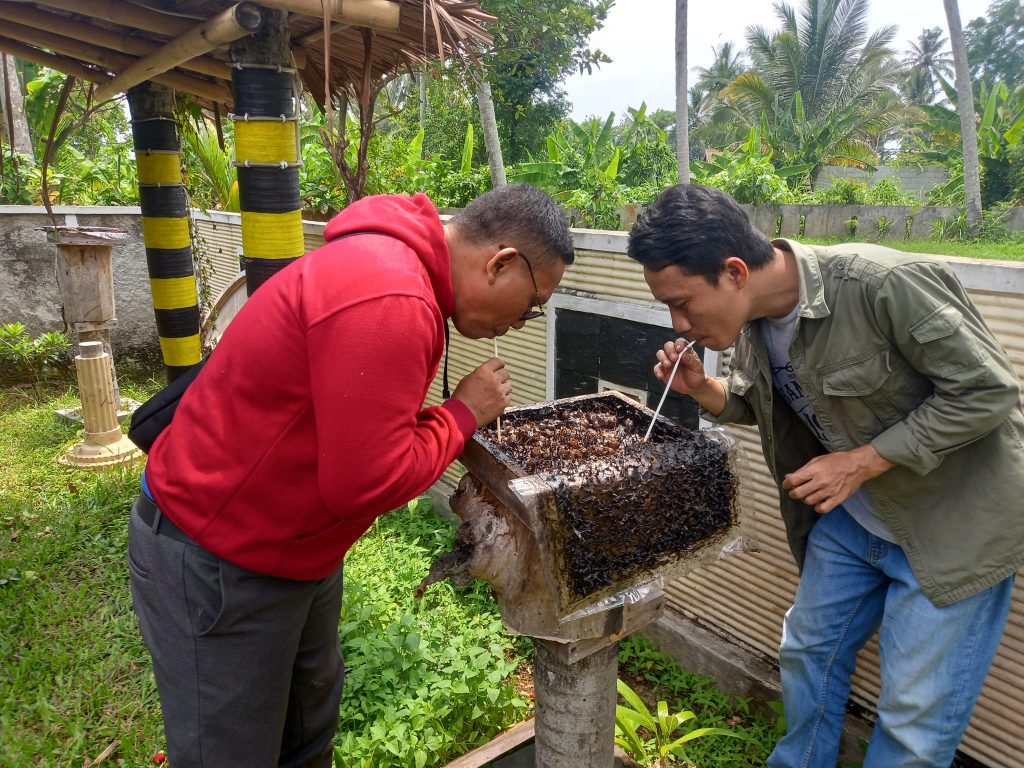
It began when a shared desire to develop the potential of Ujung Kulon’s forest honey, a non-timber forest product (NTFP), that Hanjuang Cooperative’s efforts started to enhance community business and achieve welfare for the forest village community in Ujung Kulon.
For the first time in 2006, the Ujung Kulon community advocated for an agrarian conflict related to boundary issues between community land and Ujung Kulon National Park (TNUK). The conflict centered on community honey-gathering activities. Initially, the honey collecting activity was deemed illegal and disruptive to rhino populations, but the community advocated until they gained access rights to harvest honey on Panaitan Island.
Time flew by. In 2008, through collaboration with the Indonesian Forest Honey Network (JMHI), honey-gatherers adopted sustainable harvesting and hygienic post-harvest techniques. By 2009, they began promoting and marketing forest honey, partnering with PT Dian Niaga Jakarta, a bulk honey supplier.
Hanjuang Cooperative was established on January 1, 2012, with support from facilitators and the Ujung Kulon National Park (TNUK) forest village community. It was driven by a shared desire to develop a viable community business: forest honey, a high-potential non-timber forest product (NTFP). This product became the starting point for Hanjuang Cooperative’s business.
Collective marketing was initiated in 2013 and strengthened through 2015. Forest honey production grew, reaching markets nationwide. It even caught the attention of Oriflame, a private cosmetics company, leading to a business partnership. From 2017 to 2020, Hanjuang Cooperative contracted to supply 5,000 bottles of honey monthly to Oriflame.
Various Natural Disasters Spark Honey Farmers’ Creativity
In December 2018, a tsunami devastated Ujung Kulon’s honey storage facilities. A year later, forest fires hit Panaitan Island, destroying bee-hive trees, leading to a harvest ban by the national park authority. Then in 2020, the COVID-19 pandemic hit, and Oriflame ended its partnership due to plummeting sales from social distancing measures. Yet Hanjuang Cooperative persevered. During the pandemic, they marketed honey independently via digital platforms and social media to keep their business afloat.
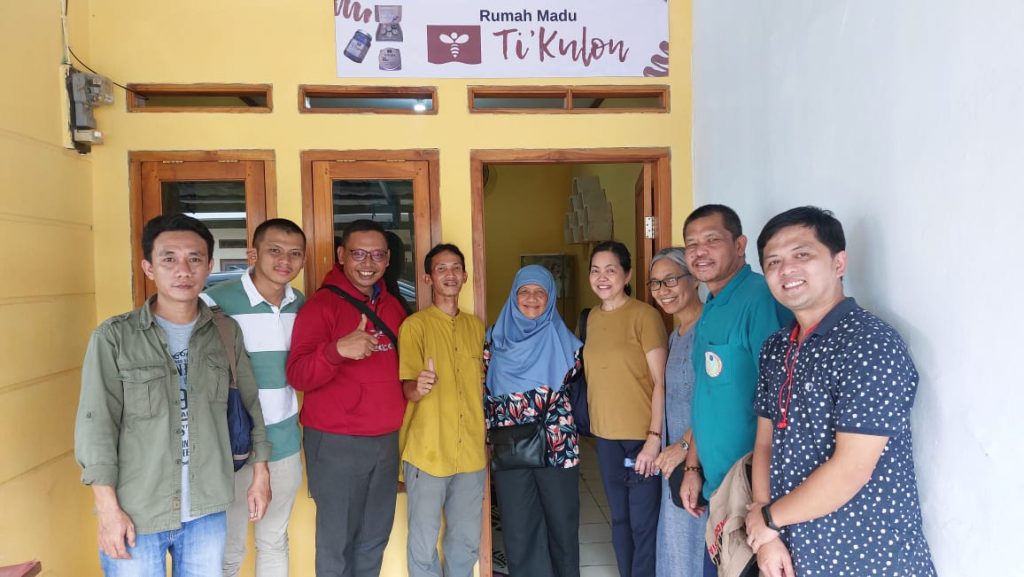
In 2021, Hanjuang Cooperative approached Ujung Kulon National Park (TNUK) via the Smart Foundation and IPB Center to reopen Panaitan Island’s honey harvest. They also began digitizing wild honey harvest data. As post-pandemic conditions improved, the cooperative needed an off-taker partner to absorb the honey harvest. In 2022, PT Rumah Madu Nusantara partnered with Hanjuang Cooperative to support nature conservation and boost community livelihoods.
“Ujung Kulon’s community relies on rain-fed farming, so during dry seasons, many farmers are idle. No rain means no farming,” explains Hanjuang Cooperative’s chair, Eman Sulaiman.
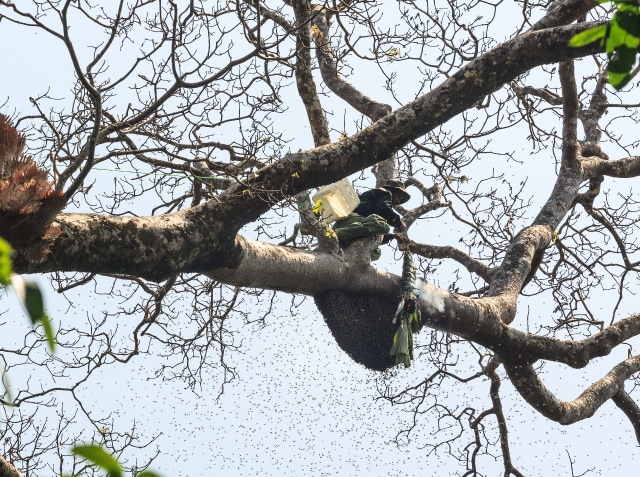
Local consumers in Pandeglang know the Apis dorsata honey as “Odeng” – giant honeybees. Odeng honey becomes an alternative income source for Ujung Kulon farmers in the dry season.
Furthermore, Eman Sulaeman added that forest honey season occurs once a year, during the dry season when forest plants are in bloom – typically August to November, with production reaching 15 to 25 tons.
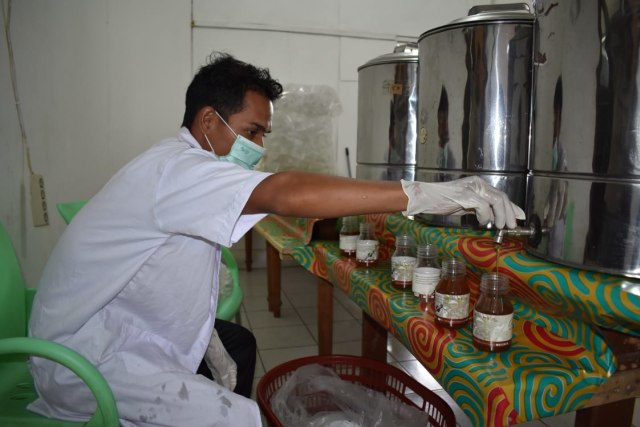
Since 2016, with support from various parties, including the Aliansi Petani Indonesia (API) (Indonesian Peasants’ Alliance), through the APFP-FO4A program, the Hanjuang Cooperative developed its business and acquired a dehumidifier technology to reduce water content, meeting Indonesian National Standard (SNI) standards for honey products.
In its development, Hanjuang Cooperative, comprising 309 honey farmers from 3 villages and 8 groups, collaborates with Ujung Kulon National Park to implement sustainable harvesting and hygienic post-harvest techniques (cutting the honeycomb above a clean cloth, not hand-squeezed), ensuring sustainable forest honey production.
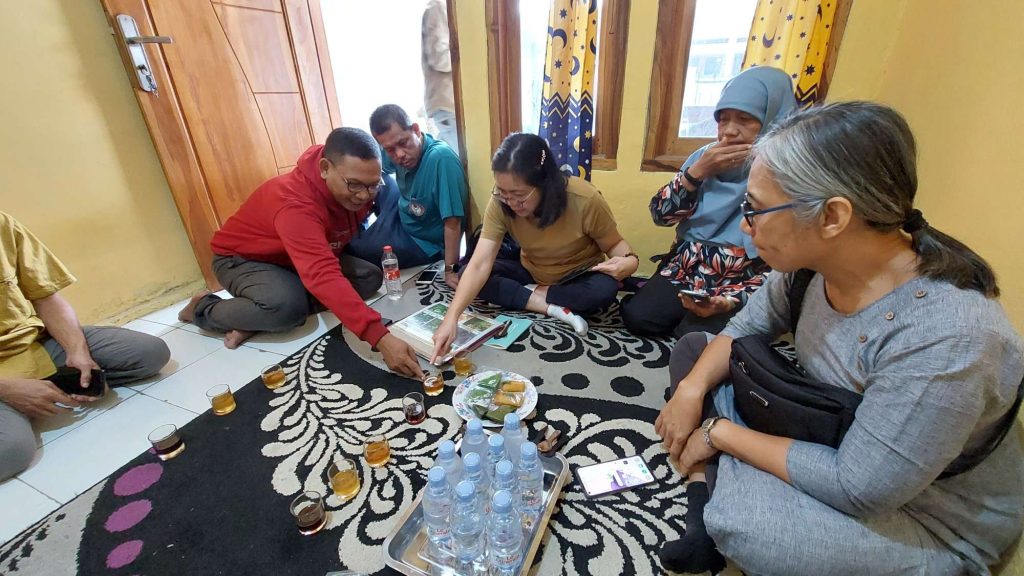
“API supported us in strengthening organizational management, including cooperative management, financial record-keeping, business development planning, and market access. Together with WWF, we mapped bee tree locations and built a product origin database,” says Eman Sulaeman. “We started with coordinate mapping and now focus on Trigona bee cultivation, which has higher propolis content.”
Currently, Hanjuang Cooperative has mapped over 500 honey trees on Panaitan Island, supported by the Japan Environmental Education Forum (JEEF) funding via the Smart Foundation.
Hanjuang Cooperative also plans organic certification with API’s Pandeglang network to innovate their business, but due to high costs, they will implement it gradually.
Eman is optimistic about forest honey’s future growth, despite challenges. Hanjuang Cooperative and API are committed to optimizing forest honey production sustainably, enhancing local community welfare.
“We’re optimistic about reaching billions of rupiahs in revenue, but fake honey remains a challenge for us. We will develop top-quality forest honey to convince consumers, while maintaining its quality,” concludes Eman Sulaeman.
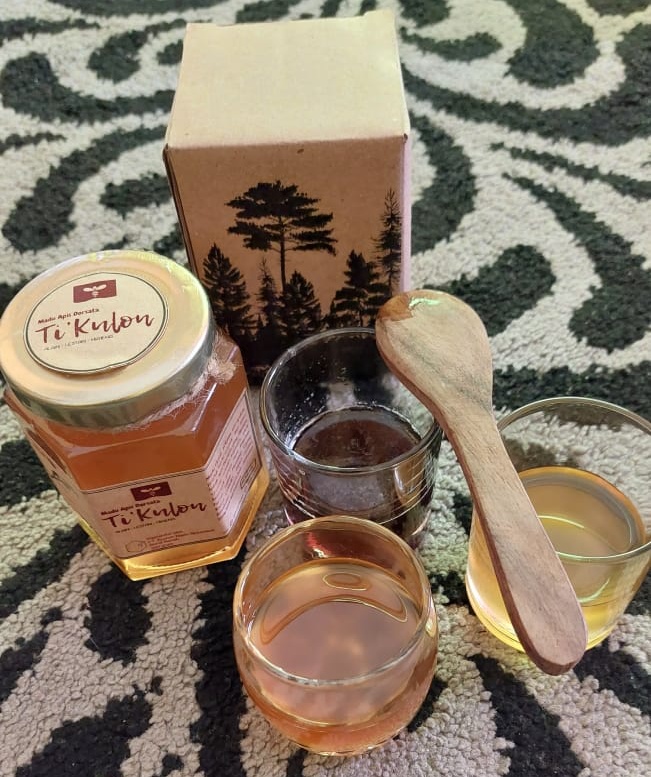
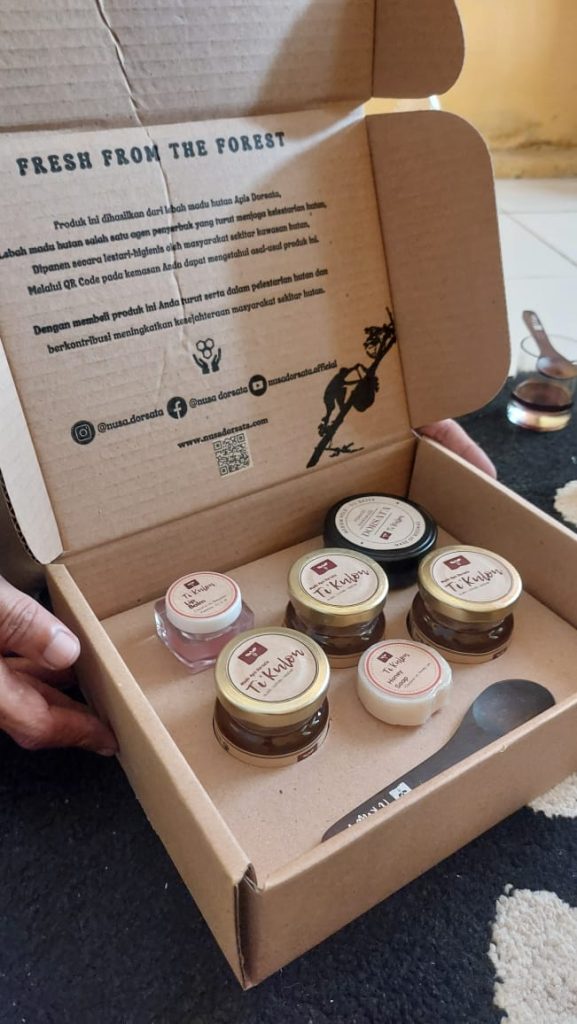
| Hanjuang Cooperative’s Products and Marketing • 200 grams of bottled honey • Honey gift set: 3 bottles of 100g honey, honey soap, pomade, lip balm, and a wooden spoon • Honey-based products: pomade, soap, and lip balm (made from honey and beeswax) • Marketing is done through a reseller network, supported by the official website, social media (Instagram, Facebook), and online stores like Tokopedia, Shopee, etc. • Impressive branding makes it easier for consumers to trace the product’s origin, including location, harvest time, and harvesting groups, via a QR code on the packaging. |