

Background
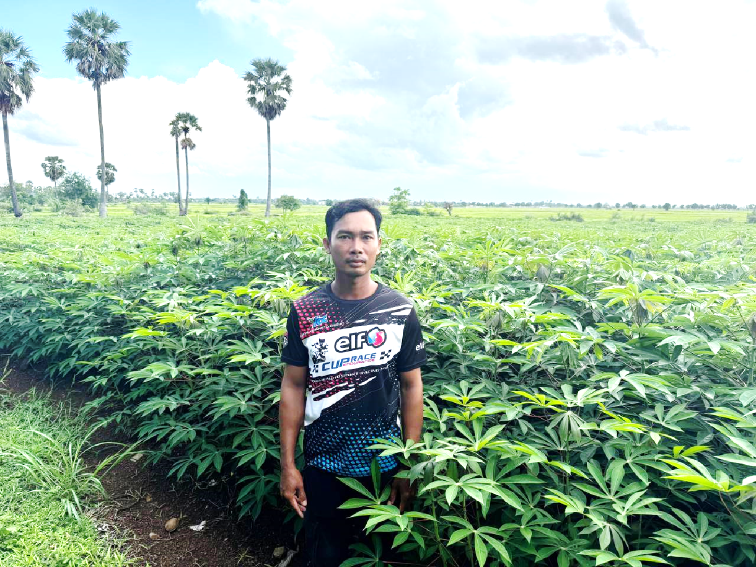
Phy Sophea, 34, living in Trapaing Chrey village, Balang commune, Baray district, Kampong Thom province, is a smallholder farmer engaged in diversified farming. He cultivates 2 hectares of jasmine rice, planting 3 hectares of cassava, and raising cows and chickens.
Since 2021, Sophea has been a member of the Balang Sethapi Agricultural Cooperative. Through the cooperative, he has accessed economic services such as purchasing organic fertilizer and selling agricultural products, as well as training and learning visits that strengthened his agricultural techniques, marketing skills, and overall farm management capacity.
Previously, Sophea practiced conventional farming methods, cultivating 3 hectares of cassava and 1.6 hectares of jasmine rice. To increase yields, he relied heavily on chemical fertilizers, achieving average yields of 27 tons per hectare for cassava and 3 tons per hectare for jasmine rice.
Over time, however, he observed declining cassava yield and quality as soil conditions deteriorated—becoming harder, less fertile, and depleted of nutrients. As production costs continued to rise, his profit margin significantly reduced. In addition, unstable market prices determined by middlemen made it difficult for him to secure fair and predictable income. These challenges prompted Sophea to consider changing his cultivation practices to improve productivity, soil health, and income sustainability.
In early 2024, Sophea learned that, with support from the APFP-FO4A program, the cooperative was promoting the use of high-quality organic fertilizers among its members to improve yields, soil quality, and farm income. He began using organic fertilizer on his cassava and rice fields, having been motivated to improve his farming practices and support cooperative-led initiatives.
A key benefit was the cooperative’s flexible payment system, which allowed him to purchase fertilizer in advance and repay the cost after harvest, helping him manage cash flow more effectively. As he actively participated and demonstrated commitment to organic fertilizer use, the cooperative selected him as a village-level distributor, enabling him to earn additional incentives.
Innovations and Good Practices
After one year and six months of using organic fertilizers, Sophea observed significant improvements in his farming system. Soil conditions improved noticeably, becoming more moist, richer in humus, and more biologically active due to increased organic matter and microorganisms. Crops appeared healthier and more resilient, with fewer incidences of pests and diseases, reducing the need for chemical pesticides.
The shift also brought health and environmental benefits. Sophea reduced his exposure to chemical inputs, minimized contamination of groundwater and surface water, and lowered overall input costs. In the long term, improved soil health has reduced the need for frequent fertilizer and pesticide applications, contributing to more sustainable farming.
Impact
While overall yields remained stable, Sophea achieved substantial economic gains. He reduced production costs by approximately 50% compared to conventional farming due to lower spending on chemical fertilizers and pesticides. In addition, the improved quality of his cassava and jasmine rice enabled him to sell to the cooperative and local traders at prices around 15 percent higher than prevailing market rates.
With increased savings, Sophea was able to purchase an additional 0.4 hectares of farmland in 2025 to expand jasmine rice production for cooperative sales and to provide sufficient, nutritious food for his family.
Through his role as an organic fertilizer promotion agent, Sophea also earned supplementary income, receiving an incentive of 5,000 riels (USD 1.25) per 50 kg bag sold. He takes pride in encouraging other farmers in his village to transition away from conventional practices, contributing to environmental sustainability, improved livelihoods, and better community health.
Challenges
Despite these successes, Sophea continues to face challenges. Climate change impacts, particularly extreme heat and flooding, have damaged crops and reduced yields in recent years. Limited access to high-quality, climate-resilient crop varieties remains a constraint. Market prices are also declining, and the cooperative currently lacks sufficient capital to purchase all member produce.
Recommendations
Sophea recommends continued support from FAEC and the APFP-FO4A program, particularly through increased investment capital to enable cooperatives to purchase more products from members at fair prices. He also requests further capacity building for cooperatives and smallholder farmers, focusing on diversified agriculture (vegetables, poultry, rice, fish), marketing, and financial management in future projects.
The APFP-FO4A program, which supports the Balang Sethapi Agricultural Cooperative through FAEC, has strengthened cooperative economic services, expanded access to quality inputs, improved farming techniques, increased income, and enhanced rural livelihoods while protecting the environment. Sophea remains committed to working closely with the cooperative, promoting organic fertilizer use, and expanding his agricultural production.
The Asia-Pacific Farmers’ Program (APFP) – Farmers’ Organizations for Asia (FO4A) is implemented by the Asian Farmers’ Association for Sustainable Rural Development (AFA) and La Via Campesina (LVC), with funding from the European Union (EU) and the International Fund for Agricultural Development (IFAD). The program aims to strengthen the capacities of farmers’ organizations to provide economic services, advocate for enabling policies, and promote sustainable livelihoods for small-scale family farmers across Asia.
Discover more from APFP / FO4A / ARISE
Subscribe to get the latest posts sent to your email.
Comments are closed