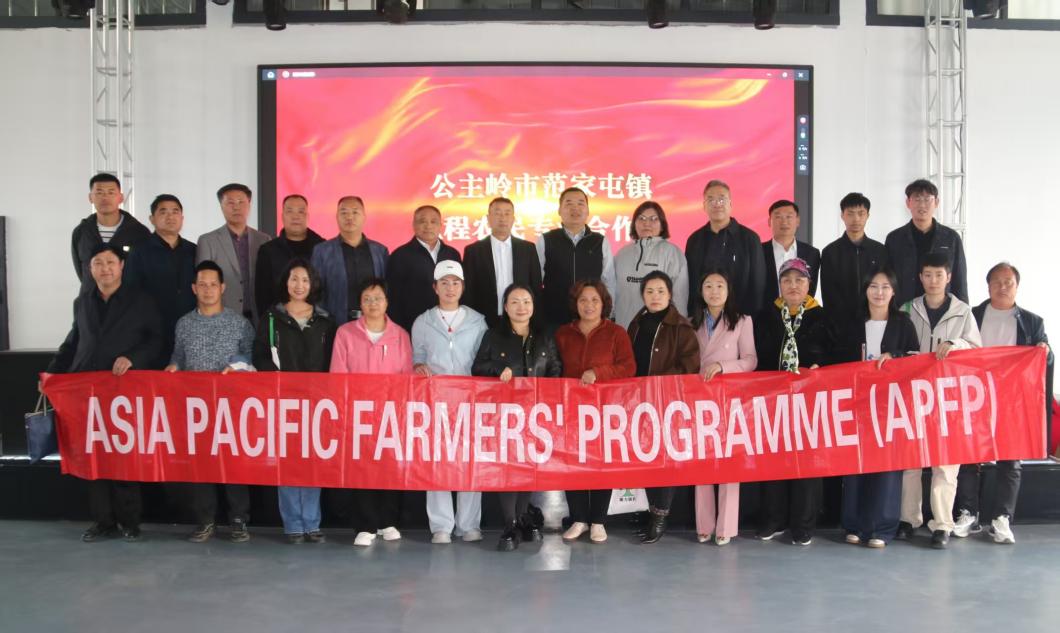

Figure 1. Activity Collection Atlas
To implement the strategic deployment of the Central Committee of the Communist Party of China and the State Council on improving the agricultural management system and promoting farmers’ cooperative operation, and to assist farmers’ cooperatives in improving quality and efficiency, and to focus on cultivating family farms, funded by APFP project, AMI held a special series of activities for the leaders of FOs who are also members of “Gathering Strength to Strengthen Cooperatives” Programme, from 25th to 28th April, 2025, in Changchun, Jilin. The summary of the activities is as follows.
- Overall introduction
The activities centered around “FO’s tax policies and agricultural product sales”, including special lectures and interactive exchanges, on-site visit and discussion exchanges, case studies, and seminar. The aim of the activities is to deeply understand the tax policies and sales methods of FOs, strengthen participants’ awareness of standardized development, explore marketing ideas for agricultural products, help agricultural products achieve high quality and good prices, and contribute to rural revitalization. 25 FO leaders participatedin the activities.
The participants are quite satisfied with this activities. The overall evaluation score of the activities is 4.99 points (out of 5 points), with an average score of 4.99 points for activities work, 5 points for homeroom teacher work, 4.98 points for reception services, and 4.99 points for overall course teaching evaluation. 19 people (76% of the total number of participants) stated that the activities has achieved the effect of broadening horizons, expanding thinking, and improving skills; 16 people (64%) stated that they have solved some of the problems encountered in their work and clarified the direction of their future work; 12 people (48%) expressed that they have reached the level of knowledge and understanding of the learned content; 13 people (52%) stated that they learned from the experiences of other sister units through communication with peers.
II. Activities Details
i. Focusing on problem needs – emphasizing professionalism, strong practicality, and wide coverage.
Before preparing for the activities, a thorough understanding of the actual needs and pain points of the FOs is the key to ensuring the accuracy and effectiveness of the course content. Based on questionnaire surveys, telephone interviews, and other methods, we will deeply collect the needs of participants, and train them to accurately target the four core demands of tax policies, modern enterprise management, e-commerce marketing innovation, and coordinated development of the industrial chain to construct a curriculum system.

Figure 2. Participants in Qiancheng Farmers’ Professional Cooperative in Fanjiatun Town, Gongzhuling City, Jilin Province
Specially invited experts from the Taxation Cadre College of the State Administration of Taxation to deeply interpret 10 core tax policies, including value-added tax reduction and income tax incentives for new agricultural entities. A professor at Jilin Agricultural University teaches management concepts and methods such as strategic decision-making and risk management for agricultural enterprises. AMI also set up e-commerce marketing practical courses to solve operational difficulties for participants through on-site explanations and Q&A.
ii. Dialogue industry benchmarks – rich experience, positive thinking, and learning attitude.
The activities organized participants to participate in immersive learning at two benchmark cooperatives, Qiancheng Farmers’ Professional Cooperative in Fanjiatun Town, Gongzhuling City, JilinProvince and Wansheng Planting Farmers’ Professional Cooperative in Hengtong, Jilin Province.
At Qiancheng Cooperative, leader Wang Cheng presented a panoramic view of the “Four Seasons Industry Chain” operation map: the layout of order agriculture in the spring planting stage, the extension of the value chain for summer processing, the branding operation for autumn harvest, and the staggered operation of winter facility agriculture. In particular, the monthly million level e-commerce sales created by the “second generation of farmers” team sparked heated discussions among participants. Hengtong Wansheng Cooperative showcased the “four-dimensional integration” development model. leader Xu Lihui opened the eyes of the participants through the three-dimensional structure of “production standardization, seedling technology, research and learning industrialization, and marketing membership”. Over the past decade, the “quality commitment membership system” has become a classic case of on-site teaching. The Q&A session in the communication section greatly stimulated the enthusiasm of the participants to participate. The participants raised questions and discussed them collectively, expressing their own opinions, forming a good learning and communication atmosphere, breaking the limitations of traditional one question, one answer, realizing knowledge sharing and experience complementarity, and further enhancing the comprehensive effect of the activities.

Figure 3. Participants actively engaged in discussions and output learning outcomes
iii. High standard organizational activities – establishing rules, strict management, and high efficiency.
The activities require participants to have a positive learning attitude, establish a sense of student awareness, and maintain integrity and self-discipline. Participants should focus their energy mainly on learning and conscientiously complete activities tasks. The AMI organizers constantly encourage the participants to combine theoretical learning content with practical production, guiding them to learn to enhance their intelligence, apply what they have learned, and gain something from what they have learned. Participantsapply the development concepts and knowledge skills they have learned to production and business activities, effectively playing a demonstrative and driving role. Strict discipline and rules ensure normal activities order, guarantee participants’ investment in activities, and win high recognition from participants.
III. Work Outlook and Suggestions
The activities achieved the expected results, realizing the purpose of the activities. The participants expressed that they would further strive for FO development, invest more energy in standardized development, and actively innovate after this activity. Cong Jiajun, leader of Huayu Planting Farmers’ Professional Cooperative in Da’an City, shared his learning experience after class: “Through these activities, I have gained a deep understanding of the tax policies of FOS and the methods of agricultural product sales, updated my ideological concepts, clarified the importance of managing farmers’ professional cooperatives in accordance with the law, strengthened my confidence and determination in the standardized operation of cooperatives, broadened my horizons, clarified the development direction of farmers’ professional cooperatives, and laid a solid foundation for the next step of strengthening characteristic industries and promoting industrial revitalization
Based on the feedback from the participants, the following suggestions are proposed:
- Appropriately extending the activities time to allow more communication time for the participants.
- In terms of course content and faculty arrangement, some advanced representatives from typical regions can be added, so that counselors and leaders can learn and draw on them during activities.
Discover more from APFP / FO4A / ARISE
Subscribe to get the latest posts sent to your email.
Comments are closed