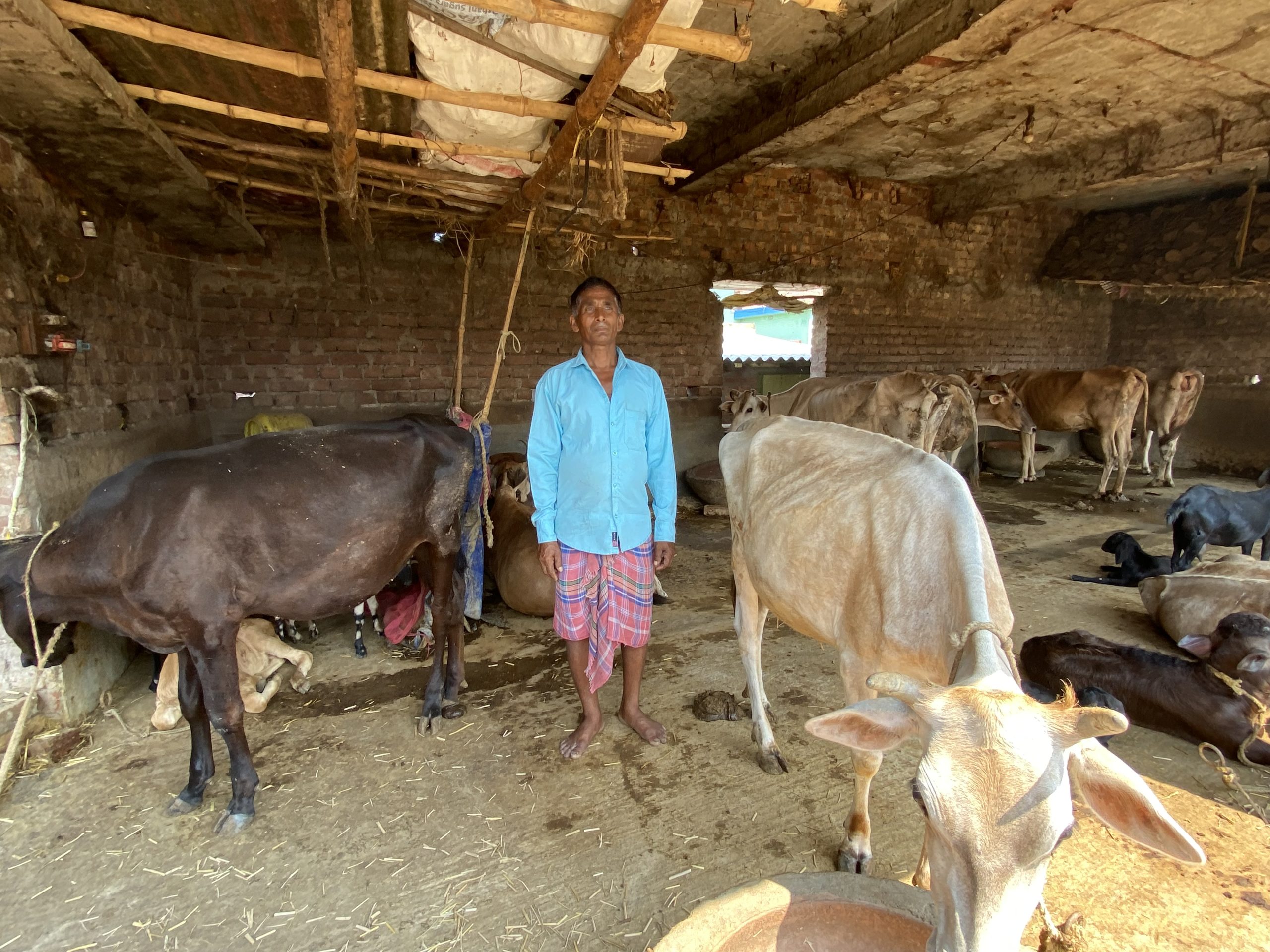
West Bengal, India – In the rural district of Birbhum, West Bengal, farmers are steadily building better livelihoods through dairy farming and cooperative enterprise. At the heart of this transformation is the Monachitura Farmers Producers Company Ltd., an organization that began just a few years ago but is already making strides in supporting its members.
The Monachitura FPC was officially registered on 4 February 2022, following a lengthy process of securing land records and farmer registrations. The Monachitura FPC has nearly 300 members, including 133 women and many youth, supported by a management team of 10 board members (two of them women). While the organization still functions at a modest scale, its vision is growing.
Before its establishment, local farmers primarily cultivated paddy and potatoes but lacked an organized system to reach larger markets. With the support of the APFP-FO4A program through the Institute for Motivating Self Employment (IMSE), the Monachitura FPC gained structure, receiving staff support, bookkeeping assistance, and guidance in registering as an organization that could function both as a company and a cooperative.
Initially, the cooperative worked on paddy procurement, supplying directly to government rice mills under annual contracts. Each cycle, farmers sell five tons of paddy collectively, generating about INR 140,000 (USD 1,590).


Potatoes became the next organized enterprise of the FPC. In 2021, the Monachitura FPC received USD 20,000 in funding, which enabled potato-growing members to increase their incomes through improved access to cold storage facilities. This allowed farmers to store their produce and sell during off-harvest periods, when market prices are generally higher than during the harvest season, when prices tend to be depressed due to oversupply.
The project also provided financial support for production inputs and established a revolving fund under the APFP-FO4A program. Farmers access this fund as planting loans at a monthly interest rate of 1%, repayable over 11 months. To date, the revolving fund has achieved a 100% loan repayment rate.
In 2023, the Monachitura FPC expanded into milk and dairy production, supported by an additional APFP-FO4A-financed business plan amounting to USD25,000. This loan also functions as a revolving fund–farmers borrow to purchase fodder, buy new cows, or invest in equipment, and repay within a year at 1% interest.


Many farmer members of the cooperative balance dairy farming with paddy cultivation but earn a larger share of their household income from dairy.
Local dairy farmers and Monachitura FPC members —including Uday Ghosh, Khokan Ghosh, Chhotan Ghosh, and Paresh Ghosh—shared their stories on how their livelihood is changing thanks to the support they are receiving from IMSE and the APFP-FO4A program.


Through the Monachitura FPC and IMSE, farmers benefit from:
- Veterinary care and vaccinations, often provided free with government support.
- Bio-supplements to improve livestock health and milk yield.
- Business services and financial planning support.
The cooperative has set up a milk hub, where farmers coordinate collection, storage, and sales. Many now own refrigerators to prevent spoilage and also make use of cow dung as fuel. Cheese and milk are sold in local markets, though farmers continue to search for larger buyers to scale production.
Already, dairy farming has brought visible change to farmer households. Families are able to meet daily needs, provide nutrition from their own products, and send their children to school. While the FPC’s overall impact is still developing, the individual benefits to members are clear.
Despite these gains, several issues remain:
- Small production volumes, limiting bargaining power with larger buyers.
- Unfair pricing and marketing gaps, with farmers often forced to sell cheaply.
- Hygiene and food safety concerns, requiring better training in clean processing.
- Animal disease risks, with many farmers lacking veterinary knowledge despite decades of experience.
- Infrastructure gaps, such as limited storage, electricity, and transportation.
Efforts to link with larger buyers such as Amul have not yet been successful. For now, most products are sold locally.
Dairy farmers are eager to:
- Develop branded, packaged dairy products for wider markets.
- Expand cold storage facilities to extend shelf life and reduce spoilage.
- Increase herd size through affordable loans, boosting milk and cheese production.
- Create specialized committees (for paddy, potatoes, and milk) to ensure accountability and better management of resources.
Recommendations from the Regional Implementing Agency include introducing a sliding grant for staffing, coupled with basic accounting and management training to build sustainability. The next step is for farmers to focus on savings and financial literacy so they can reinvest wisely. With stronger organization, training, and infrastructure, the Monachitura FPC has the potential to grow from a small village hub into a resilient, self-sustaining enterprise.
The Asia-Pacific Farmers’ Program (APFP) – Farmers’ Organizations for Asia (FO4A) is implemented by the Asian Farmers’ Association for Sustainable Rural Development (AFA) and La Via Campesina (LVC), with funding from the European Union (EU) and the International Fund for Agricultural Development (IFAD). The program aims to strengthen the capacities of farmers’ organizations to provide economic services, advocate for enabling policies, and promote sustainable livelihoods for small-scale family farmers across Asia.
Discover more from APFP / FO4A / ARISE
Subscribe to get the latest posts sent to your email.
Comments are closed