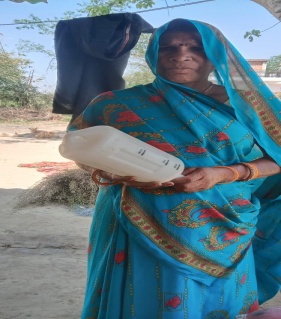

Uttar Pradesh, India – In the small village of Khadri, in Raibareli district of Uttar Pradesh, lives Sampada Devi, a 35-year-old farmer and mother of four. She and her husband, Ram Avatar, along with their two sons and two daughters, depend on a modest half bigha of farmland for their livelihood.
Life was never easy, but things became even more difficult when Ram Avatar met with an accident. With limited resources, it fell on Sampada to shoulder the responsibility of keeping the family afloat. She began cultivating vegetables on their tiny plot, but the income was barely enough to cover household expenses, let alone her children’s education.
It was during this challenging time that a SEWA aagewan (community leader) visited her village. In a community meeting, the SEWA leader introduced local women to the organization’s services, as well as government policies and schemes that could support them. Sampada decided to join SEWA and was soon connected to a cluster of farmers.
Through SEWA, supported by the APFP-FO4A program, Sampada received training from the Krishi Vigyan Kendra (KVK) on vegetable farming, covering crops such as mushrooms, tomatoes, and capsicum, as well as the use of organic fertilizers. With the knowledge she gained from the training, Sampan was ready to improve her farming practices.
Her efforts were further strengthened when the SEWA Raibareli team provided her with a solar pump. The pump transformed her farm work: irrigation became easier, yields nearly doubled, and she no longer had to worry about electricity bills or the rising cost of diesel. By adopting organic techniques and using natural manure, Sampada not only reduced input costs but also grew healthier, more nutritious vegetables.
With higher production came the challenge of accessing better markets. Once again, SEWA stepped in. The aagewan connected Sampada to cluster-based market linkages, ensuring she could sell her produce at fair prices. To prevent wastage of leftover vegetables, she even set up a small shop in her village. This additional effort brought her more income and stability.
Today, Sampada proudly shares that her yields are better in both quality and quantity, and her income has doubled. She can now meet her household expenses and support her children’s education—things that once felt out of reach.
Grateful for the support she received, Sampada says that SEWA’s constant guidance has given her the confidence to stand on her own feet. What started as a struggle for survival has now turned into a story of resilience and hope, showing how women farmers, when empowered with the right tools and knowledge, can transform their lives and communities.
The APFP-FO4A program is implemented by the Asian Farmers’ Association for Sustainable Rural Development (AFA) and La Via Campesina (LVC), with funding support from the European Union (EU) and the International Fund for Agricultural Development (IFAD). The program aims to strengthen the capacities of farmers’ organizations to provide economic services, advocate for enabling policies, and promote sustainable livelihoods for small-scale family farmers across Asia.
Discover more from APFP / FO4A / ARISE
Subscribe to get the latest posts sent to your email.
Comments are closed