Background
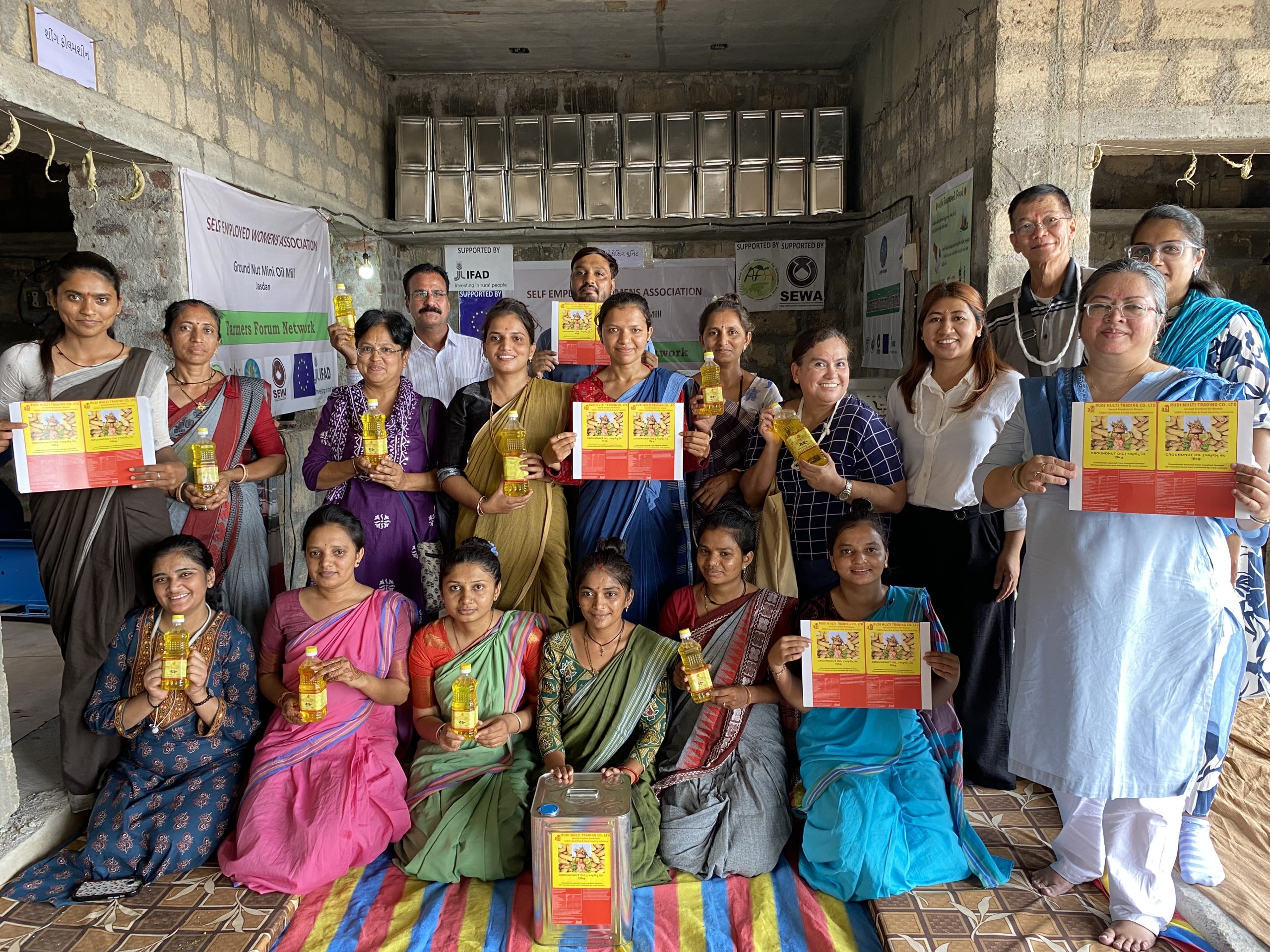
The Jasdan Peanut Oil Mini Mill is a women-led processing unit established by the Self Employed Women’s Association (SEWA) in the drought-prone, rain-fed region of Jasdan in Rajkot district in Gujarat, India.
Around 60% of farmers in the area cultivate groundnut (peanut) during the Kharif season, while others grow cotton, fodder, and a few other crops. Farming in this region is challenging and unpredictable. For years, farmers in the area struggled with high cultivation costs and the non-availability of essential inputs, such as seeds, fertilizers, and pesticides, at the time when they were most needed. This situation left them dependent on local agro-dealers, who often sold expensive chemical fertilizers and pesticides. Farmers used them heavily, spending as much as INR 60,000 (USD 660) every month, but the soil became hard and difficult to till, and the profits remained low.
Innovations and Good Practices
To address these issues, SEWA initiated a pilot cluster of 150 farmers from two villages. Working collectively brought a change in approach. Farmers were trained in scientific methods of groundnut cultivation and learned to prepare natural fertilizers such as jivamrut. By applying this, they saw their land improve, and what was once hard soil became soft and fertile again. The shift from chemicals to natural inputs reduced costs drastically, from about INR 60,000 (USD 660) to just INR 5,000 (USD 55) per month, while maintaining or even improving yields. Group procurement of seeds and inputs further reduced expenses by 15–20%, and technical support improved production outcomes. For the farmers, the change was not only about reducing costs but also about regaining control over their land and farming practices.
While working together in the cluster, women farmers identified another long-standing problem: the sale of groundnuts. Earlier, they had no choice but to sell in distant markets, where they often had to wait in queues for up to two days just to make a sale. In addition to losing time, they paid for tractor rentals and other expenses during this period, and yet the prices they received were not fair. Many of them had no bargaining power and were forced to accept what traders offered. It was during these discussions that the idea of starting a local oil mill took root, an enterprise that could buy groundnuts directly from farmers at fair prices, reduce dependence on outside markets, and also create employment for women in the village.
After exposure visits and feasibility studies, a group of five women who had been trained under the cluster program came forward to lead the effort. They were determined not only to set up the unit but also to manage it themselves. The Jasdan Peanut Oil Mini Mill was formally launched in 2023–24, with support from the APFP-FO4A program, which provided financial assistance of USD 9,084. This support provided the unit with a strong foundation, making it possible to purchase the necessary machinery and cover the initial setup costs.
From the beginning, the mill has been fully operated by women. They manage every aspect of the business, from the procurement of groundnuts from local farmers, machine operations, extraction of oil, packaging, sales, and even the management of accounts. The oil is sold in local markets, while the by-products, such as oil cake, are also monetized, ensuring that nothing goes to waste. In its first year of operations, the mill procured about 28,600 kilograms of groundnuts and produced around 8,650 kilograms of oil. The women operators now earn between INR 8,000 and 10,000 (USD 89 and 111) per month through sales of oil and by-products. This income has been a source of economic independence for them and has demonstrated what women-led enterprises can achieve when given the opportunity.


Impact
The benefits, however, extend beyond the operators. Farmers now have a local market for their groundnuts, which means they save time, reduce expenses, and get better prices. Instead of sending money out of the village to traders and middlemen, income stays within the community. For local households, especially poor families, access to pure and safe oil has also improved. Earlier, many families had to buy oil from outside, without knowing its quality, and often it was too expensive to buy in large quantities. Now, the mill produces oil in smaller bottles as well, making it affordable for even the poorest households. Families are assured that what they consume is pure, healthy, and made in their own village.
The oil mill has also created pride and dignity for women. For the first time, they are not only cultivators but also processors, business operators, and decision-makers in a value chain that was once controlled entirely by men and traders. As one farmer explained, “Earlier, our money used to go outside the village. Now, our money stays with us. Our sisters manage the mill, and we get good prices for our groundnuts.” This sense of ownership has strengthened collective solidarity among women.
Today, more than 200 women are engaged in groundnut cultivation linked to the mill. Together, they have built an enterprise that supports both farming and processing. The oil produced in Jasdan is sold locally and in nearby villages, and through SEWA’s RUDI network, it reaches other districts such as Ahmedabad, Anand, and Dhangadhra. The women have also established direct ties with institutions like hostels and hotels, which now purchase their oil every month. These partnerships provide a stable and regular market for their product and increase the visibility of the enterprise outside the immediate community.


The Jasdan Peanut Oil Mini Mill has become much more than a processing unit. It is an example of how a small but strategic intervention can transform rural livelihoods. By combining sustainable farming practices with decentralized processing, it has reduced cultivation costs, generated employment, ensured fair markets for farmers, and improved access to healthy, safe food for families. The initiative has shown that when women come together, receive the right support, and take leadership, they can build resilient local economies rooted in their own knowledge and resources.
The initiative introduced practical innovations that reshaped how groundnut farming was practiced in the area. The cluster-based approach to groundnut farming was a departure from traditional, isolated farming practices. Farmers, particularly women, were trained collectively on scientific cultivation techniques, including soil health improvement through jivamrut (natural fertilizer). This replaced costly chemical fertilizers, reducing monthly input costs from INR 60,000 (USD 660) to just INR 5,000 (USD 55), while improving soil quality and sustainability.
The establishment of a women-operated oil mill directly addressed the longstanding challenges farmers faced in marketing. Previously, farmers had to travel to distant markets, often waiting for days and incurring additional costs like tractor rentals, with uncertain returns. The mill created a local, reliable market, ensuring fair prices and retention of income within the village economy.
Nehalben, one of the women managing the oil mill, proudly shares, “We, sisters, handle everything ourselves: procurement, processing, packaging, bookkeeping, and marketing.” She adds, “We are grateful to SEWA, AFA-LVC, IFAD, and the EU for creating new livelihood opportunities. Through the oil mill initiative, we are also able to provide pure and nutritious groundnut oil to our community.”
The project introduced a full-cycle women-led operation from procurement to processing and sales, ensuring women gained skills in enterprise management, technical operations, and market linkages. The mill also monetizes by-products like oil cake, adding further economic value.
The innovation lies not only in establishing a processing unit but in integrating farming, processing, marketing, and women’s empowerment into a single, replicable model. This approach is scalable to other clusters where women farmers grow groundnut or similar crops, combining agricultural productivity with local value addition.
The initiative has led to a significant improvement in women’s livelihoods. Before joining the oil mill, the women worked as farm laborers and earned only INR 150 (USD 1.50) per day, and that too only on the days they found work. After starting operations at the oil mill, their income has increased significantly, and they now earn INR 10,000 (USD 111) per month. The increase in income has enabled the women to spend more on their children’s education, household needs, and health-related expenses, improving overall family well-being.
For the women engaged in groundnut farming through cluster formation, the trainings provided under the APFP-FO4A program have helped reduce the use of DAP, urea, and chemical pesticides. This has lowered their input costs by 15–20%. Through collective marketing, either selling directly to the oil mill or to the market, farmers save both time and transportation costs, and also receive a fair market price, since earlier they were often paid less with the excuse that their product quality was “sub-par.


Beyond the women operating the oil mill, the initiative has generated wider employment opportunities within the community. More than 200 women have been mobilized across the value chain, engaging in groundnut cultivation, oil production, and sales. This expanded participation has strengthened local livelihoods while reinforcing women’s roles as active contributors to the rural economy.
Training in the use of natural fertilizers such as jivamrut has helped improve soil quality while significantly reducing dependence on chemical inputs. This shift has supported long-term land health, strengthened environmental sustainability, and made farming practices more resilient in the face of changing climatic conditions.
The production of high-quality, pure groundnut oil has improved food security and nutritional quality for local families. Previously, households relied on purchased oils of uncertain quality, which often raised health concerns. With locally produced oil, families now have reliable access to safe, nutritious food they can trust.
By keeping production and sales rooted within the village, the project has strengthened the local economy and ensured that income circulates within the community rather than flowing to outside traders. At the same time, sales have expanded beyond the village to nearby districts and institutions such as hostels and hotels, increasing both the visibility of the enterprise and its overall revenue.
Facilitating Factors
Several enabling factors contributed to the success of the initiative. A strong collective organization of farmers into clusters created a foundation for collaboration and shared learning. SEWA’s capacity-building support in agricultural practices and enterprise management equipped women with the skills needed to operate and sustain the oil mill. Exposure visits and feasibility studies further strengthened the confidence and technical knowledge of the women operators. Initial financial support from SEWA made it possible to invest in essential infrastructure, while steady local demand for high-quality, safe groundnut oil ensured the enterprise’s market sustainability.
Challenges
The initiative also faced several challenges along the way. Convincing farmers and women to shift from traditional, chemical-intensive farming practices to the use of natural fertilizers initially met with resistance. Limited technical skills in operating oil extraction machinery required focused and continuous training. Expanding markets beyond the local area involved building trust with new buyers and maintaining consistent product quality. In addition, ensuring a reliable supply of groundnuts remained a challenge in the rain-fed, drought-prone context, particularly when meeting production targets during difficult seasons.
Lessons Learned
Several key lessons emerged from the experience of the Jasdan Peanut Oil Mini Mill. Community-driven solutions are most effective when women are placed at the center of both production and marketing, as this fosters accountability, trust, and strong local ownership. Continuous training and exposure play a critical role in building women’s capacity in agricultural practices and enterprise management, enabling traditional activities to evolve into sustainable livelihoods. Integrating farming with local value addition significantly amplifies impact by strengthening incomes and reducing dependence on middlemen. Creating local markets enhances resilience by keeping value within the village economy and reinforcing both financial and social stability. Finally, the initiative demonstrates that simplicity in innovation can be powerful. Practices such as using jivamrut for soil health and establishing a small-scale oil mill show how modest interventions can lead to meaningful, system-level change.
Recommendations
To build on the successes of the Jasdan Peanut Oil Mini Mill, several recommendations emerge. Governments and development agencies should promote cluster-based, women-led agri-processing units in other regions, providing essential support through low-interest loans, training programs, and technical guidance. The model can be scaled to other crops, such as cottonseed, sesame, or mustard, by combining agricultural clusters with localized value-addition facilities. Establishing market linkages with institutions like schools, hostels, and hotels can help stabilize demand and enhance profitability for rural women entrepreneurs. Emphasizing sustainable practices, including the use of organic soil enrichment methods like jivamrut, will reduce chemical dependency and strengthen long-term agricultural resilience. Finally, development programs should ensure that women are engaged not only as laborers but as decision-makers, operators, and business owners, reinforcing leadership and ownership at every level of the enterprise.
Related Documentation
Discover more from APFP / FO4A / ARISE
Subscribe to get the latest posts sent to your email.
Comments are closed