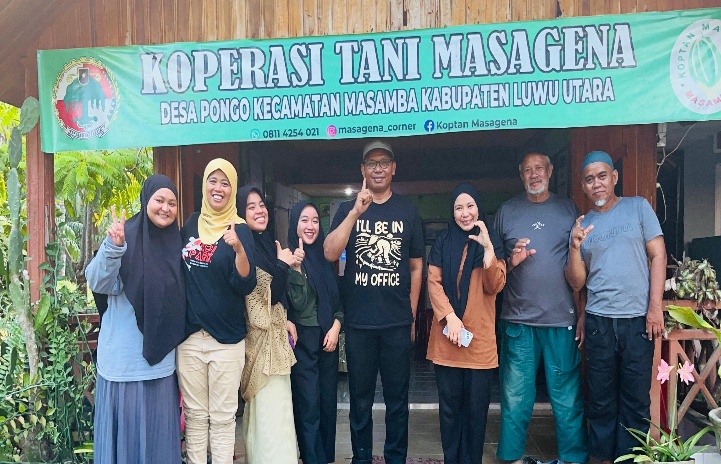
The Koptan Masagena (Masagena Agricultural Cooperative) is based in Pongo Village, Masamba District, North Luwu Regency, South Sulawesi Province, Indonesia. The cooperative is optimistic about improving the welfare of cocoa commodity farmers in its working area in North Luwu Regency.
The Chairman of the Koptan Masagena, Ayu Antariksa Rombe, stated that cocoa farmers still need ongoing education and assistance. The assistance covers various important aspects, ranging from certification assistance to give farmers better bargaining power, processing of cocoa derivative products, and fermented cocoa. Not only that, but non-cocoa products they produce also need attention, and equally important, cocoa producers need expanded access and clear market information.
Moreover, farmers also need to be equipped with an understanding of proper marketing strategies, as well as how to maintain and improve product quality to be competitive and have added value in the market. Clear and accessible information is key so that farmers not only produce, but also understand the direction and business opportunities they are pursuing.
She emphasized that cocoa farmers need to be taught to remain consistent and committed to their farming business. This commitment must be built without neglecting the three most fundamental things, namely sustainable production, inclusive markets, and other supporting conditions that enable cocoa farming to grow sustainably and equitably.
“The effort being done is empowering groups to support sustainable cocoa certification programs, which have been ongoing for more than 10 years, so that farmers understand and apply the applicable Good Agriculture Practice (GAP) standards. It’s not just about good cultivation practices (environmental aspect), but this process also covers social and economic aspects. This long process is expected to have a positive impact and real benefits for farmers,” says Rombe.


To achieve this goal, Koptan Masagena works with various Non-Governmental Organizations (NGOs) such as Rikolto Indonesia, Aliansi Petani Indonesia (API) (Indonesian Peasants’ Alliance), and Cacao Sustainability Partnership, Chalodo Chocolate, as well as involving academics, local government at the district level, and development partners. In addition, collaboration is also built with cocoa industry players, the private sector, and various other collaborative partners in the cocoa value chain. This program is facilitated by API through the APFP-FO4A program to strengthen cross-sectoral synergy and ensure program sustainability.
The Asia-Pacific Farmers’ Program (APFP) – Farmers’ Organizations for Asia (FO4A) is implemented by the Asian Farmers’ Association for Sustainable Rural Development (AFA) and La Via Campesina (LVC), with funding from the European Union (EU) and the International Fund for Agricultural Development (IFAD). The program aims to strengthen the capacities of farmers’ organizations to provide economic services, advocate for enabling policies, and promote sustainable livelihoods for small-scale family farmers across Asia.
To develop the cooperative business, API also provides business incubation for the Masagena Cooperative and provides additional facilities such as a drying house and fermentation boxes with a much larger capacity and more production than before. The cooperative also gains cooperative management development and business assistance, as well as capacity building for cocoa farmers, including training, workshops, socialization, and other efforts related to improving farmer resources and the farmer organization itself.
Not only that, but cocoa farmers are also encouraged to prepare products and market their various products to segmented markets. Thus, market negotiations run smoothly. The various products marketed include fermented beans, raw cocoa beans, wet cocoa beans, cocoa seedling businesses, fertilizers, and processed foods.
“The cooperative is an umbrella for the farmers we work with. How the cooperative can access the market from the first hand, have direct contact with buyers, facilitate the marketing of farmers’ products at a much better price or better bargaining position, and that’s what we need,” said Rombe.
The cooperative is currently developing the Masagena Education Center (MEC) as a Cocoa Clinic and addressing other issues currently faced by cocoa farmers in the program area to develop and provide capacity building to group members participating in the organization, including attracting young farmers to participate in the program. Furthermore, young people are given capacity building and introduced to smart farming, not just about tools that can improve their performance in the agricultural sector, but also how they can develop and be empowered in the agricultural sector.
In the future, farmers will not only focus on cocoa commodities. They also develop other commodities to maximize the available land with an intercropping system. For example, in cocoa plantations, ginger, papaya, pineapple, durian, banana, avocado, and other plants with added value are planted. This effort will increase farmers’ income that supports the local economy. Although floods once inundated around 80 percent of cocoa plantations, the improvement and recovery efforts were expected to restore soil fertility while strengthening the resilience and sustainability of farmers’ agricultural businesses.
Discover more from APFP / FO4A / ARISE
Subscribe to get the latest posts sent to your email.
Comments are closed