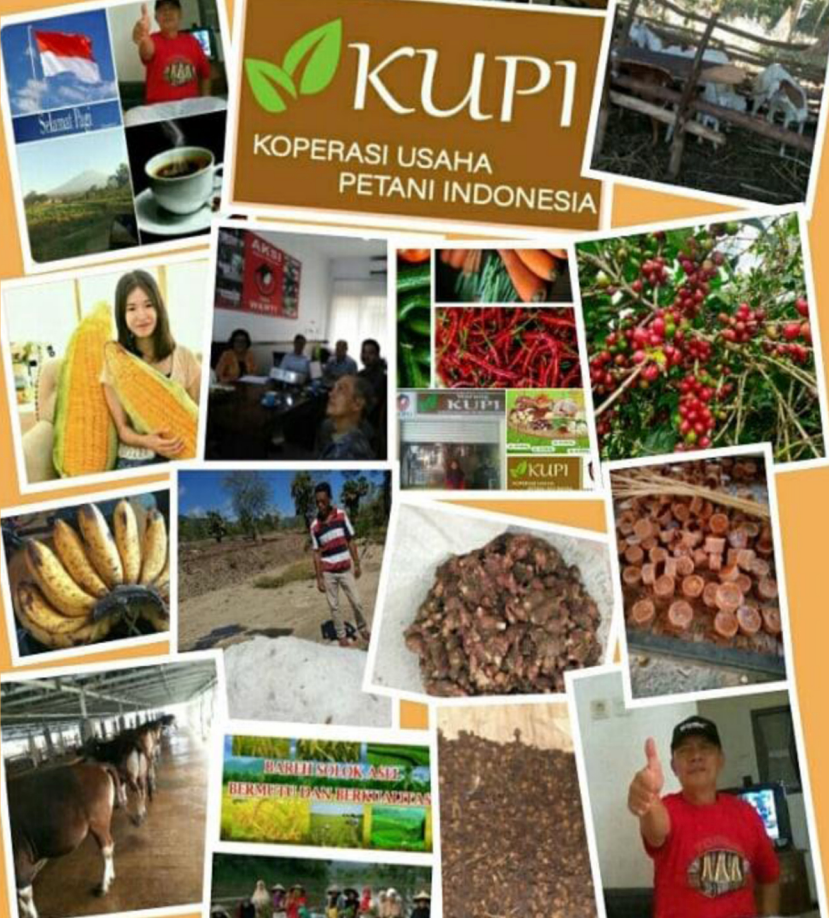
The Wahana Masyarakat Tani Indonesia (WAMTI) (Indonesian Farmers and Fisherfolks Community) commits to improving the welfare of farmers and fisherfolks. One of these commitments is realized through the services of the Indonesian Farmers’ Cooperative Farming Business (KUPI) with a village-based youth business program.
KUPI (Koperasi Usaha Tani Petani Indonesia) or Indonesian Farmers’ Cooperative Farming Business is a socio-economic service targeting farmers and fisherfolks in underdeveloped areas. Through young farmers’ activities, this cooperative mobilizes rural businesses, especially in the food crops sector, to play an active role in achieving national food security.
KUPI runs a wholesale trade business for agricultural commodities, including white rice, red rice, forest honey, coffee beans, live cattle, and fish. This enterprise is supported by the APFP-FO4A program. The Asia-Pacific Farmers’ Program (APFP) – Farmers’ Organizations for Asia (FO4A) was implemented by the Asian Farmers’ Association for Sustainable Rural Development (AFA) and La Via Campesina (LVC), with funding from the European Union (EU) and the International Fund for Agricultural Development (IFAD). The program aimed to strengthen the capacities of farmers’ organizations to provide economic services, advocate for enabling policies, and promote sustainable livelihoods for small-scale family farmers across Asia.
Djohersah Djohan, Secretary of KUPI, stated that the program at KUPI is based on the desire to strengthen the agricultural sector, thereby increasing producer income and improving the welfare of farmers’ lives.
“We increase farmers’ agricultural yields to the maximum, so that rural businesses can improve the welfare of farmers themselves with sufficient capital, marketing, seeds and fertilizers, and a good technology system,” explained Djohan.
In addition to commodity trading, this cooperative also provides assistance. For example, collaborating with young farmers aged 17-35 in optimizing food crops and secondary crops, organizing agribusiness education and training, holding member savings programs for purchasing calves, and productive forest tree planting programs (agroforestry).
With technological advancements and existing opportunities, KUPI encourages the active role of young farmers through Rural Business (Uped). In Uped, young farmers are assisted to become drivers of collective rural businesses. The goal is to build
strategic and systematic rural cooperation in each region based on technology and market, so that farmers can be more independent and the welfare of farmer households in rural areas can be achieved.
“We plan to create a pilot project in Lebak Regency, Banten or in Subang Regency, West Java. We create a rural business program that attracts young farmers, so that the position of young farmers becomes more strategic in the collaboration on rural business management,” added Djohan.
The goal is for young farmers to collaborate and strengthen farming businesses. For marketing and program realization, Djohan explained that they will also roll out cooperation with government and private parties or overseas markets. He hopes that Indonesian farmers and fisherfolks will become stronger in managing food crops.
“Our target is indeed farmers. Currently, farmers’ capacity is still limited. For example, land is not extensive, lack of capital, and market access,” he said. “In my opinion, the current transition of farmer generations, and the spirit of rural communities is not
yet enthusiastic about developing rural businesses. Now, we will organize rural youth to be willing to farm to build a better future and make their lives more prosperous”.