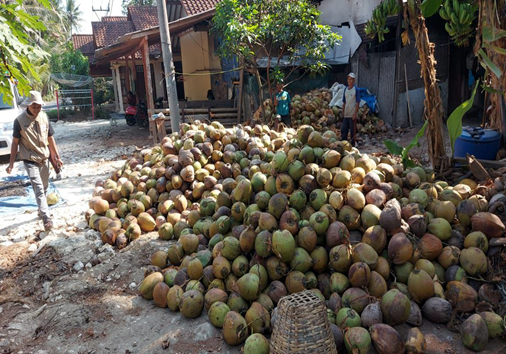
Coconut is a key income source besides food crops for millions of farming families in Indonesia, playing a significant role socially, culturally, and economically. However, low prices make it hard for farmers to earn a decent income. Traditional production methods also affect product quantity and quality. With APFP-FO4A support, through its cooperative unit, JAMTANI launched a sustainable coconut processing program focusing on coconut oil in Cikembulan Village, Sidamulih sub-district, Pangandaran District/Regency, West Java Province. Through organized collective efforts, farmers enhance their independence, income, and climate resilience.
Pangandaran in West Java, Indonesia, is a region with abundant coconut resources. Coconut has high economic value since almost all parts – roots, trunk, leaves, and fruit – can be used for various culinary and non-culinary purposes. The flesh is often processed into various products, while by-products like husks, water, and shells (often used for charcoal) also have economic value.
With a lifespan and harvest period of over 20 years, coconut trees offer tremendous benefits. Yet, farmgate prices remain low, around IDR 1,000-1,500 (USD .059-.088) per coconut. This makes it tough for farmers to earn a decent income. Recently, another issue emerged: high market prices did not benefit coconut oil farmers, as they preferred selling directly to big middlemen at slightly higher prices. Meanwhile, cooperatives struggled with capital to absorb large-scale coconuts amidst soaring market prices with capital to absorb large-scale coconuts amidst soaring market prices.
Coconut oil is a high-potential coconut product. As people become more health-conscious, demand is rising. However, production in Pangandaran is still traditional, using simple, inherited technology. This affects quantity and quality–maximum production is 2,400 kilograms per month, with oil that is prone to rancidity, has a short shelf life, and is not suitable for long-distance distribution.
Besides the high coconut supply prices, low awareness of pure coconut oil consumption, and limited market access, farmers face another challenge: improving human resource quality for cooperative and farmer group managers. Additionally, administratively, government support for legality, product certification, and nutrition labeling is lacking. This hinders local coconut oil’s competitiveness in broader markets, keeping farmers’ and businesses’ turnover low. This is where guidance on diversifying coconut products becomes crucial.
To address these challenges, the Jaringan Masyarakat Tani Indonesia (JAMTANI) (Indonesian Farmers’ Network) launched a sustainable coconut processing program focusing on coconut oil in Cikembulan Village, Pangandaran, through its cooperative unit, the Koperasi Jamtani Pangandaran (KPJ). This sustainable coconut processing program aims to strengthen cooperatives’ role in coconut oil processing, improve productivity and quality, and increase income for farmer groups in Cikembulan, namely Galendo Si Madu. It is also expected to create jobs for locals, especially women and youth, and strengthen the local economy through broader market access for coconut products. In addition, JAMTANI also focuses on women’s and youth’s roles in creating inclusive, community-based farming models.
JAMTANI has 156 identified sub-national organizations (SNFOs) with 1,401,995 male members, 600,855 female members, 210,299 young males, and 90,128 young females, totaling 2,002,850 farmers. While the Koperasi Jamtani Pangandaran coconut oil unit, Galendo Si Madu group, has 34 male members, 20 female members, 14 young males, and 8 young females, totaling 76 members.
Galendo Si Madu, a coconut oil processing group in Cikembulan, is an economic institution formed by JAMTANI, with farmer members selling coconut parts as extra income. Galendo Si Madu farmers dry coconut flesh into copra as an adaptive measure for poor-quality coconuts due to weather and storage. Processing into copra salvages lower-grade coconuts for coconut oil production, reducing losses and ensuring group production continuity.
This coconut oil commodity boosts farmers’ income through increased productivity, better prices, added value, and market access. One big off-taker of coconut oil is a herbal medicine and cosmetics company in Yogyakarta.
Diversifying products (coconut value chain) like husks, water, shells, and leaves also increases earnings. Production costs are lower using local natural materials. With APFP-FO4A support, farmers learned that diversifying harvest processing improves value and strengthens group economic resilience against climate and market challenges. JAMTANI plays a key role as a bridge between small farmers’ interests at the local level and strengthening farmer organizations nationally and regionally, while showcasing inclusive, fair, and sustainable community-based economic development models.
Program impact on members’ income
In 2023, the Koperasi Jamtani Pangandaran received USD 20,000 from the APFP-FO4A program for its business plan on coconut processing.
The Asia-Pacific Farmers’ Program (APFP) – Farmers’ Organizations for Asia (FO4A) is implemented by the Asian Farmers’ Association for Sustainable Rural Development (AFA) and La Via Campesina (LVC), with funding from the European Union (EU) and the International Fund for Agricultural Development (IFAD). The program aims to strengthen the capacities of farmers’ organizations to provide economic services, advocate for enabling policies, and promote sustainable livelihoods for small-scale family farmers across Asia.
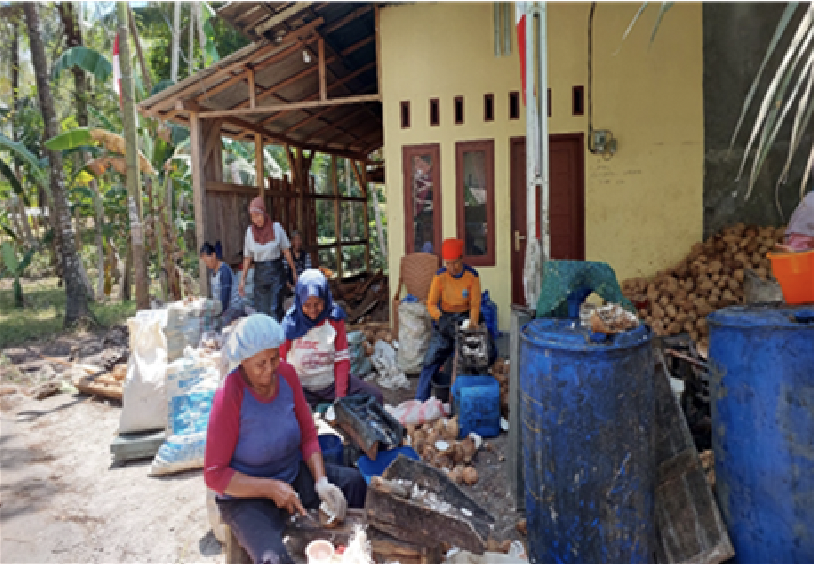
The APFP-FO4A program in Pangandaran contributes to increased farmer household income. The program improves the livelihoods of small farmers in Galendo Si Madu by creating new jobs, including coconut pickers, collectors, transporters, peelers, scrapers, shredders, cooks, filterers, packagers, marketers, waste sellers, distributors, and more. Eighteen (18) people are involved in new livelihoods created by the program, aside from the 236 farmer families as direct beneficiaries. The group consolidated 12,792 coconut trees from 78 hectares of farmland and utilized 160 hectares of rice fields and dry land. In addition, the program strengthens farmer families’ independence and climate resilience.


Coconut flesh is dried into copra by Galendo Si Madu farmers as an adaptive measure for poor-quality cocos due to weather and storage. Processing into copra salvages lower-grade cocos for coconut oil production, reducing losses and ensuring group production continuity. With APFP-FO4A support, farmers learned that diversifying harvest processing improves value and strengthens group economic resilience against climate and market challenges.
Coconut oil processing contributes to food and nutrition security. Seventy-six (76) farmer families in Galendo Si Madu sustain their family farming businesses. For food and cooking needs, farmers typically set aside 5-10 coconuts per month (IDR 30,000 -60,000 value) (USD 1.77-3.54). For members with small bakeries, grated coconut is used in cakes, needing 5-15 coconuts per month (IDR 30,000-75,000 value) (USD 1.77-4.42). While coconut water for nata de coco sells at IDR 10,000 (USD .59) per jerigen, with 30 jerigen per month orders (co-op managed), worth IDR 300,000 (USD 17).
Members also utilize unused coconut parts as additional resources. Coconut husks replace firewood for cooking, saving IDR 150,000 per week (USD 8) (1 kolbak), or IDR 600,000 (USD 35) per month. Coconut meal waste is sold as livestock feed at IDR 4,000 (USD .24) per kilogram, with 200 kilograms per month used, worth IDR 800,000 (USD 47).
Through collective and organized approaches, the group reduces logistics costs, ensures raw material supply, and increases production efficiency. This achievement is a tangible result of APFP-FO4A’s support, strengthening institutional and group-based business systems at the farmer level. Galendo Si Madu members increased their income. Before the program, the group earned IDR 1,000,000 (USD 59) per month collectively. After joining the program, income rose to IDR 1,700,000-2,000,000 per month (USD 100-117).
| Jobs or livelihoods accessible to farmers and monthly group expenses are as follows: a. Coconut pickers (usually paid by coconut plantation owners) b. Transporter (3 people with 1 mobil pick-up car with fees IDR 100.000 per day (IDR 100,000 X 3 people x 12 times a month = IDR 3,600,000) c. Peelers = IDR 100 per piece (total 1,000 pieces of coconuts) of 7 peelers (IDR 100,000 x 7 x 12 times a month = IDR 8,400,000) d. Scrapers: 15 people (IDR 500 per kilogram x 30 kilograms x 15 x 12 times a month = IDR 2,700,000) e. Cleaner and shredders: 1 person x IDR 100,000 per day x 12 times a month = IDR 1,200,000 f. Coconut graters = 1 person x IDR 100,000 per day x 12 times a month = IDR 1,200,000 g. Cooker = 1 person x IDR 100,000 per day x 12 times a month = IDR 1,200,000 h. Filters and packaging = 1 person x IDR 100,000 per day x 12 times a month = IDR 1,200,000 i. Sellers = 1 driver IDR 500,000 x 3 times a month = IDR 1,500,000, plus 2 assistants x IDR 200,000 x 3 = IDR 1,200,000 |
Achievements
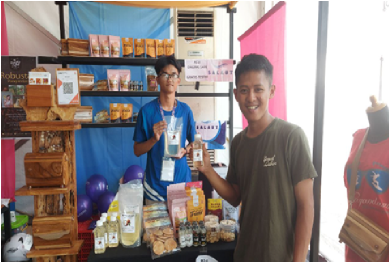
The coconut oil produced by Galendo Si Madu has production permits, and farmers are expanding digital market access. This shows JAMTANI and farmer-led businesses improve technical and economic services in rural commodity value chains. Individual producers and small farmers benefiting from JAMTANI’s economic initiatives include 120 male, 72 female, and 35 young farmers in the coconut oil value chain.
JAMTANI, as a channel for farmers’ information and aspirations, influences policies and agricultural business environments towards family farm transformation and sustainable, inclusive local economic initiatives. It builds farmer-led agri-enterprises successfully, evident in JAMTANI’s involvement in shaping national and local policies as a farmer organization.
| Flagship Product: Coconut Oil (Value chain developed by Galendo Si Madu Group) | |
| Description | Total |
| Commodity | Kelapa Coconut Oil Processing |
| Service provided | Capacity developing; Raw material management; Technical training on product processing; Packaging; Access to capital; Access to marketing; Products distribution; Creating collaboration with government institutions in terms of product quality enhancement training |
| Volume of production (kilogram, pack, ton, etc) | a. Coconut oil 42,28 tons per year b. Galendo 12, 788 kilograms c. Coconut shells 27,768 kilograms d. Coconut water 1.213 jerigen/container |
| Selling value | IDR 2,116,142,000 |
| Cost of production | IDR 1,704,060,000 |
| Gross profit | IDR 412,082,000 |
| Operational cost | IDR 213,252,900 |
| Net profit | IDR 198,829,100 |
In policy advocacy, JAMTANI involves farmers – men, women, and youth – as member representatives in consultations and policy dialogues (15 people: men, women, young farmers).
Government policies and programs accessible to farmer organizations include coconut cultivation training (via Pangandaran Forestry Department), business licensing, halal certification, SMEs development, and market access facilitation (via Cooperatives Department, SMEs Department, BPJPH Halal, DPMPTSP).
While good communication between JAMTANI and stakeholders like the Health Department (product quality), SMEs Department (marketing), and Forestry Department (coconut cultivation) supports the program’s success.
JAMTANI is accountable, runs its functions effectively (farmer organization professionalism), equips a structure aligned with roles, a business flow per plan, and diverse membership (men, women, youth) in fair proportions.
| Value of coconut products marketed (all value chains) by Galendo Si Madu members (in IDR/USD) | |
| Products | Total |
| Coconut oil : 80,350 kilogram x IDR 23.000 | IDR 1,848,050,000 (USD110,883) |
| Galendo : 12,788 kilogram x IDR 10,000 | IDR 127,880,000 (USD 7,672) |
| Coconut shell: 27,768 kilogram x IDR 1,000 | IDR 27,768,000 (USD 1,666) |
| Coconut water: 1.213 jerigen (container) x IDR 5,000 | IDR 6,065,000 (USD 3,639) |
Galendo Si Madu, with management assistance from JAMTANI cooperative, identified high-value commodities, improving members’ income and sustainability. They handle raw material supply, technical training, product processing, and marketing.
Direct beneficiaries are 78 farmer households. Indirect beneficiaries total 312 people: 78 households x 4 family members, plus 15 workers in the value chain. Galendo Si Madu members are producers, production workers, marketers, and distributors in the value chain.
Locally, farmers access government programs supporting family farming transformation. Though no direct policy influence, Galendo Si Madu shifted mindsets from selling raw materials to post-harvest processing and value-added products. This success stems from RIA-IFAD support, providing funds, training, and capacity building for institutional and cooperative growth. With this, Galendo Si Madu accessed funding, technical training, and business mentoring, expanding markets and boosting product value collectively.